BETWEEN BIKES BOATS AND BANANAS.
“Where do I begin,
To tell the story of how great this
life has been,
To show the meaning of what life is
meant to be.” (Frank Sinatra)
What are the important things, the
ordinary doings, the exciting or the unusual events ?. What makes us what we are
and what we believe ? What leads to happiness and
contentment, the hallmark of my whole life ?
THE START OF IT ALL. Parents.
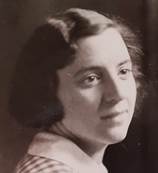
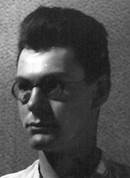
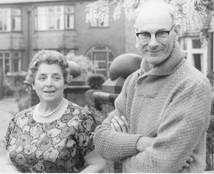
I count myself extremely lucky to
have been born to the parents that I had. My childhood was one of complete
contentment, and truthfully never a bad experience. Their love of me and of
each other drove all their actions, and it appeared to me that we wanted for
nothing. All through my life I have been accompanied by 'a lucky fairy' a
guardian angel or some factor that usually makes things turn out OK. God's hand ?
Born in 1936, I was really too young
to remember the War. My father was a Conscientious Objector, refusing to accept
his call-up and being taken to court to give his reasons. He was a very
enthusiastic follower of Ghandi and his teachings,
and I was a teenager when I saw Dad cry when Ghandi
died. He was a member of the Peace Pledge Union, and as we lived on the
outskirts of the town, he went out into the centre of
Manchester at nights to help with the injured in the bombing. Once I do remember that when he came to have
a break, in his rucksack, he found my teddy instead of his expected snack, and
Mum and he laughed about it when he returned.
He said that he could not believe what men were prepared to do to one
another in the name of
'Duty to ones country'. I did not realise
the seriousness of all this at the time, or until much later in life. I only
remember sitting playing with my toys under the kitchen table, and once during
daylight there was a barrage balloon that we could see from the kitchen window
that had gone wrong and was rushing around on its tether..
Once too, at night, a stray bomb fell on the nearby golf course, causing no
damage, but breaking some of the crockery in our pantry. For some time we had two large brick air raid shelters built in the
avenue, though I have no memory of them being built or being removed. One was right outside our house, long and
thin with rows of benches inside. I don’t think we ever went in one during a raid, but
as young children we did use them as a 'den', hiding and sitting telling rude
stories or rhymes away from adult eyes.
Before I reached 18 and my own call-up due for the
forces, Dad gave me a book to read by Tolstoy, War and Peace, which was then,
and now, far beyond my understanding, but I have grown to admire and agree with
his views on mankind and the importance of loving ones neighbour.
Though I have no memory of it, my
mother was very ill after I was born and was even confined to a wheelchair for
a while I believe. Our next door neighbours the Oaks's were very close and were a great help in looking after me as a baby.
I think my earliest memory is of a
pedal car. Even though I have since seen photographs of it, I can clearly
remember one special day. Dad used to drive a blue Bedford lorry collecting
sacks of potatoes from farms around Cheshire, and selling them to grocers and
chip shops in Manchester.. One day Mum and I went with
him and on the way to the farm we collected my pedal car from a garage in
Stockport where it had been mended by a welder. When we reached the farm, Doanes in Cheshire, Dad was loading the potatoes, and I
think some pears, and Mum took me in my car along the country lane. The feeling
of going on a journey, somewhere I did not know, pedalling
round the bends and seeing more freshly gravelled
road ahead, feeling the gravel under the wheels, was really exciting, and
remembering that special feeling when I am exploring now, takes me right back
there. I think that special excitement
of being in a new place and exploring must have been born in me, as it still
gives me the greatest kick.
EARLY LIFE AT 19 REPTON.
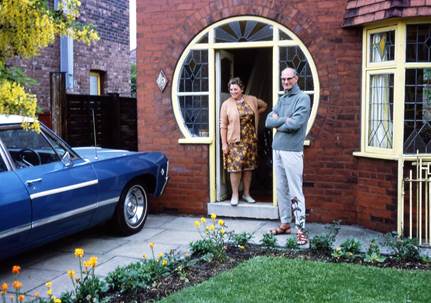
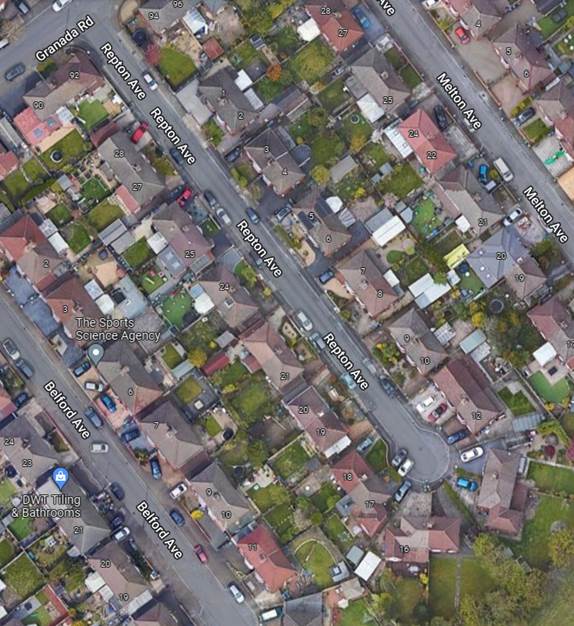
There were 28 houses in the Avenue,
arranged 10 each side and 8 forming a circle at the top, the cul de sac. Number 19 was just before the circle on the
right as you walked up the avenue. We
knew all the residents, the other children, and those who did not have family,
who was friendly, or who kept your tennis ball if it went over the wall by
accident. There were several children around my age.
Opposite at 10 was Roy Hubbard exactly my age,
and his sister Ida 2 years older. His father worked for a big grocery chain,
Co-op manager I think, and was an active member of the Salvation Army. On New Years Day morning the treat was always when his band came
up the avenue playing Christmas Carols and collecting door to door. I think he
was my best friend, and we took him with us on holiday twice I think when we
were 5 or 6, to Cleveleys or Whitby. Also, he had been an 'evacuee' during the
war, and so perhaps came to live opposite when I was 5 . Later his father started a spare time project
making frames for spectacles out of perspex. In their
garage he had a treadle fretsaw machine , which I was
allowed to use a couple of times and from then on always wanted one for myself.
I had to wait a long time, but eventually at Calthorpe Park school, one of the
parents donated an old broken 'Hobbies' machine exactly like Mr Hubbard’s, and I was probably 40 by then. Quickly repaired, it still did good
service with many a young pupil pulling a face as they tried to co-ordinate
feet, hands and eyes, quite tricky really.
Roy went to a private primary school, and later we went to different
secondary schools, but Dad encouraged him to ride with us and the Cycling club
and he stayed riding and racing regularly until after I left for college. I
have a photograph of his lovely gold Hobbs of Barbican after he had wrecked it
by going off the edge of a road on a club run. He started work at the age of
16, training to be a 'cutter' in the tailoring trade, and later became a very
successful salesman for Cadburys. I think he donated his 'sprints and tubs'
(racing wheels) to Steve when he quit racing
Next door at 18 were the Oaks's, with Audrey, just 2 years older than me , but we were very close. She came on holiday with us
once too, to Blackpool, When I went to school, it was she who walked me there
and back and I can remember sitting at the back of the hall when she was practising in the choir, waiting for her to walk home with
me. She had piano lessons too which she
hated, specially the practicing., but I quite envied
her. Mr Oaks worked in a paper factory and brought us
misshaped envelopes and offcuts of paper in big stacks, and small sheets of
card that I used for models. Mrs Oaks worked in a bakery in Denton, which I visited with
Audrey occasionally. Once she brought home a huge lump of almond paste which I
ate, and then felt very sick, so to this day, almond paste reminds me of this
over indulgent occasion. Mr and Mrs
Oaks used to shout at one another, clearly heard over the fence, as our back
doors were only ten feet apart. I don't think that they were unhappy together
but I know that they 'rowed' frequently, something that NEVER happened with my
parents. Audrey too became a keen cyclist with the club, not racing but touring
and weekends, and she married one of my best cycling friends, Barry Haylor.
Next door to her was Brian Marshall
at 17, who was
2 years younger than me, and he had a much younger sister Janet. He had infant
polio, but I don't remember it stopping him joining in our games. I do remember
once, as we both got older, him telling me that he was catching me up in age,
quite a concept for small kids to grasp. I also have fond memories of spending
time at weekends or holidays playing card games or dominoes with his parents,
though his Dad smoked a smelly pipe which I did not
much like. One incident that is still
clear in my mind is getting a real telling off, because of something I did
which was very naughty. Brian and I must have had an argument over something,
and to get my own back I sneaked into their garden and pulled up some carrots
and spilled a bottle of milk. My mother told me in my later years that I was
always a 'goody goody' and never did anything wrong,
so perhaps this occasion was a real blot on my copybook.
Brian had relatives who lived at
High Lane, Disley, beyond Stockport, and once we rode there on my tandem, and
sitting in a back garden playing a record player, I heard my first Hawiian guitar, and though I did not know what it was at
the time, I very much enjoyed the sound of it.
Another girl my age was Joyce Holmes
from number 25, and her brother Raymond who also worked on the railway, was as
old as Stephen. Her Dad was a railway footplate man I
think. She and her husband Terry visited us once after we moved down to Odiham.
Jean Griffiths, as old as Audrey, lived
opposite Joyce but she never joined in with games in the avenue. I think her
parents must have been older perhaps and she was kept indoors most of the time.
Next door to Joyce was Keith Bellamy a year older than me but he also never
joined in games and kept himself to himself. Mum told me that the Belamys would not speak or look at us because Dad had
refused to fight in the war.
As we all grew, younger children
took over in the Avenue. Number 21 had
two boys, and 23 the Cronshaws two more, next door to
Joyce , 26 Stuart and young sister, 27 the Kirkbrights, John, younger than me had drowned at about 4
years old, later had Christine, Steve's age,
and twins Jeane and David, who stayed good
friends with Steve, my brother. His best friend was however, Geoffery Wade from 16, who's Dad was a bus conductor. I
know that it was a quiet but known fact that his dad was in prison for a short
time for stealing some of his conductor’s money.
Next door to us at 20, were several
families, initially the Wilds, who had no children, then the Kenyons who had children about Steve’s age, and when they moved away, it
was the Harveys, Norman and Eunice, when I was a late
teenager I guess, who had children even younger than Steve. When I was at
College, Dad bought Hi
Fi, components, amplifier and turntable and radio, and I helped him to
construct a cabinet for them. The speakers was a huge
affair, five feet tall and filling one corner of the living room. It had a 15 inch base speaker, a 10 inch mid, and two small 'tweekers mounted separately on the top. The cabinet was of
half inch mahogany ply panels with a half 8nch filling of sand in between, so it
weighed a ton, but gave a fantastic quality of sound. Norman used to bang on
the dividing wall to indicate that Dad should turn UP the volume so they could
hear, Ray Connif's Orchestra, was their favourite. They remained good friends even when they had
all moved to new locations.
Playing games outside was usual.
'Please Mr Fisherman, can we cross the water ?' was a favourite, when you
needed to know all the names of film stars or other famous people, and we had
times of the year when roller skates were all the rage, or marbles, or stilts.
Making stilts out of empty dried milk cans with strings attached was fun, or
from sticks of wood with blocks fixed to them One time we had found some pieces of
round metal on a dump, which I now realise were dies
for cutting threads on steel rod. We
would skim these along the road surface and make great sparkes,
specially at night.
I skimmed mine once and it went straight through a neighbours window, smashing the glass. When Dad came
home from work he rushed out to buy a new window pane
and putty, and it was all back OK very soon. I know they realised
that it had been a big mistake but I was quietly told to be more careful in
future. From another dump we would
collect different coloured 'swords' and 'daggers',
which I now know were pop rivets, to be used in the aircraft industry
Almost every day there were various traders up the avenue, a daily milk horse
and cart from the local dairy, who ladled milk from a churn into your own jug. Mum would
not buy his mik as she came from a farming background
and said that his dairy 'Raistricts', was not clean.
Weekly the 'rag and bone man' also with donkey cart, shouting 'bone' in a loud
voice. He would exchange any old clothing or household items for coloured 'stones' that were used to put a temporary
clean surface on the doorsteps. I don't recollect ever giving him bones, but I
think he collected them too. All these animals brought sought after manure, in
piles in the avenue and it was a race to pick it up for the garden. I had a
tinplate barge pulled with
a string and used that as personal manure transport.
We rode all round
the estates on tricycles and bikes, with games of tag and hide and seek. As we got older and more daring, as Winter
drew in with early dark nights, it was knocking on doors and running away, and
once we were chased by a man who came out and caught me because he said I was
the biggest. He grabbed me and the others ran off to tell my parents, but he
let me go after a good telling off, but he scared us to bits. Incidentally, we
really respected the police, and the promise of "I'll tell the Bobby", was a
real threat to be taken seriously.
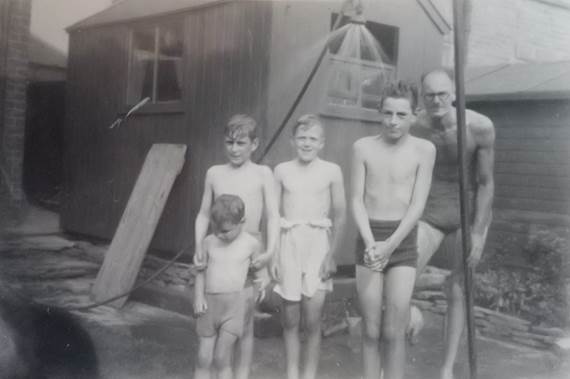
In the Summers, which
I remember as being long and hot, we had pretend
tents in the gardens, using the clothes horse and old sheets. I ran my 'O'
gauge trains round the back lawn, and we had showers under a hosepipe. All the
rage was 'french knitting' done with an old cotton
reel with 4 nails in the end. This device was used with a blunt needle and small balls of wool
to produce a long fat woven string, which then could be sewn up to make mats or
purses, but the pleasure was in making a longer rope than your friends. Milk
came in glass bottles with cardboard circles as sealed tops. These had a pop
out centre so that it could be pulled out with your
finger and discarded. We used to collect these and thread them on string,
hundreds of them, quite useless really, but a few could be used to make 'bobbles'
which were fluffy woollen balls, once again with
almost no useful end product. We all had the usual paints and crayons, and I
specially used to love making things out of cardboard and glue. Cheap glue was
a mix of flour and water, but it took ages to set. We made a cheap modelling
clay out of flour and water with salt added so that our shapes would set
hard. Harbutts Plasticine was best, it smelled good
and had bright colours to, coming in 8"long
slabs of 5 round strips each.
Sweets were almost unobtainable,
sugar was rationed, as was milk meat and almost all foodstuff. Mum made balls
of cocoa and dried milk with some sugar.
She had an arrangement with the milkman, who came used an electric
vehicle, that any milk left over at the end of his round, she would buy off
him. This was quite illegal of course, and once I told this in a primary school diary, and the teacher
told Mum, who then had to explain to me that I should not spread around this
information.
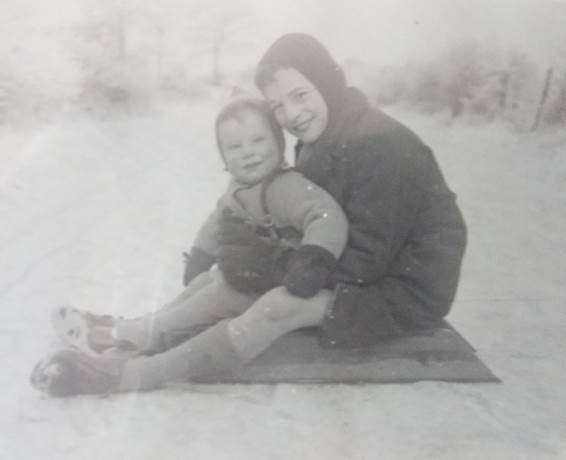
Winters were always snowy and sometimes for
weeks it would lie on the streets getting blacker by the day. people used to
clear their own paths, but often they were icy and dangerous to walk on,
specially at nights. We built snowmen of course, in our gardens and on the
avenue, and had snow fights. I can remember standing in the kitchen sink and
crying as 'mi Mam' gently washed off my cold legs and feet, with raw chafed
bits where my wellie tops had rubbed my calves. We had sledges too, Dad made me a small one
with varnished softwood and steel runners that was the envy of all my friends
as it slid so well, even on an icy road. There were not many hills close by, but occasionally we
got to try a real deep snowy slope. We
made great long slides
on roads and pavements which the neighbours called
dangerous. After dark we would all
gather round the
street lamp to play and talk, which did not please number 14, the
Gallagers as they had no children and the lamp was
outside their front garden. I don't remember any lamps in the avenue at all.
There was some waste ground and a
clay-pit close by, with a stack of unused railway lines, and a wooden garage
were Mr Hamnett, (number
13, no kids) kept his lorry. A very sad time was when one of the smaller
children, John Kirkbright, (number 26, sister
Christine and later , twins, Jean and David ) was drowned in the old
clay-pit which was unworked and full of
water. When Dad came home from work, because he was very tall, 6ft 2inches, he
rushed off to try to find John. Mrs Kirkbright never got over losing him at the age of about 4
I think
We close neighbours,
Audrey, Roy, Brian and myself fixed up a 'phone' system once. We had tin cans
with a hole in the bottom through which was a string and a knot on the inside.
The string was pulled taught between our bedroom windows and when we spoke, the
words could be heard across the road. Audrey and I could not be connected
because the house corner got in the way, though we were the closest.
We four plus Joyce were the oldest
in the avenue, which of course was new housing and filled with young couples as
were Mum and Dad. As we got older more children were born, like Stephen. At 21
were Peter and Geoffrey Milne , 22 had two boys, the Cronshaws, and Ian McEwan at 15, Geoffrey Wade at 16 same
age as Steve, and others after that. One boy Stuart, at 26 used to have fits
and was not very well, and he had a younger sister. And so the avenue life
developed, everyone friendly and helping each other, taking other children on
walks etc..
The best walk was to Denton woods, specially for my birthday in May when we could pick
bluebells, and there was an old fallen tree trunk where we had our picnics.
Reddish Vale, in the same direction, up Windsor Road and into the country. Here
were pig stys, cows, a dairy, and bluebell woods with
a stream we used to dam, and trees to climb. Strange it may seem but it was on such a walk that the
concept of mothers fathers and children was explained as I looked at young
piglets, sex education as it used to be ! Also we
passed a huge hollow in one field where we were told a spitfire plane had
crashed landed.
It was all very open and friendly,
with people chatting at their gates, and visiting each other for cups of tea
etc. One interesting point was that
there was only one house out of the 28 that had a car. Number 15, the Gallagers were older than most, with an invalid lady who
lived with them, and
they had a small car, guessing now at an early Ford or Austen 7. If we were very lucky and caught
them in the right mood we could catch a ride to the bottom of the avenue, a
real thrill. Our family never had a car, we occasionally got a lift from neighbours who would take us to the station for holiday
travel.
At the bottom of their garden was 'the
country' fields and crops and cows and a pond with fish frogspawn and mud.
Occasionally we could go through their garden fence, a gate by the garage, to
catch minnows with our nets and jam jars. later we could ride or walk round
without using their garden, and one day I had a big accident in these fields.
We were running along one day when I ran into a barbed wire fence that I
had not seen, and got a huge cut on my eyebrow which bled profusely. I still
have the scar. Looking back on those days, the really drastic change that I see
is that even close neighbours now, hardly ever see
one another, and certainly could not be considered as friends. Maybe one
difference is that ‘southerners’ are much less casually sociable than the
‘northern’ folk where I grew up.
When Dad started work as an
accountant at J&T Peters, it was with horse and carts, but later, they got
a Bedford lorry and it was then that he started driving. In the yard next to
Gorton Railway Goods
Station they eventually had two lorries but the carts were still
there, and used to store bags of potatoes. One lorry had a wooden garage. It
was next to the office which was also a wooden shed, that smelled strangely and
had a typewriter that later I used to play with. The other lorry was kept in
the stables, a two story brick building, with a ladder
up the wall through a hole into the top floor. Here were stored the hessian
bags and balls of string to tie them , and it smelled
of hay and hessian and occasionally of rotting potatoes, but it was always an
adventure to climb up the ladder and play.
Talking of vehicles, I know I used to see, while visiting Uncle Oswald,
a steam truck, rounded at the front with a smoke chimney on the top of the
driving cab. It had solid tyres and was used to
transport mixed mortar and concrete, from a yard on Chapman Street where there
were huge round containers with stone rollers rotating inside. I went to the
yard once when Dad wanted some mortar to put in a new back door step.
Afterwards a man came to face the step with polished stone. Previous to that
Mum used to wash the step each week and 'stone' it, which put a coloured coating on the plain concrete step.
Primary School
West End Primary School, too has
good memories. I had a gas mask like a
Donald Duck, which we had to carry to school, but I never got to use it. I
liked all my teachers, specially the first one Miss Clayton, who had a sand pit
in her room. The last one too, Miss Parkes, was a favourite
as I was allowed to take my fret saw to school, and when the other boys did knitting, I was allowed to make a plywood frog which waved
its legs when you pulled the string and was painted in two shades of green. We
also made puppets for a model theatre she used in her classroom. I was always making things in wood. I still have a small church which I gave to
my lovely favourite auntie Nellie, (Dad's mother's
sister), and somehow it later came back into my possession, though I can still picture it on her
mantelpiece over the blacked fire grate and oven.
Making things has always been my
greatest pleasure, a trend started by my Dad with his model boats
, and fitting out our kitchen with cupboards and a drop down worktop,
well before DIY became the normal thing to do. We originally had a 'pantry' in
the corner of the kitchen. with only a small window next to the back door, and
in there was a marble slab shelf. where the milk was kept, and other wall shelves. Dad knocked
this out and changed the whole kitchen layout.
It was
encouraged by teachers all through my early years.
I was 7 years old when my brother
Stephen was born, and to be honest, I don't remember much about him being
a baby. I remember him lovingly as "ah
kid", but I can not think of many events where
he was part of my early life, and it is only much later that he became a
friend. I'm not sure why this is, or what shaped our relationship. I never felt
he was in the
way, and I don’t think we had disagreements but I don't remember playing with
him, but he had a collection of plastic farm animals, and at school I made a
farm yard I think for Christmas. We both had Dinky Toys, and he had a super
tractor which could be steered. By the time I went to college at 18, he was still a boy,
with a great collection of Eagle
comics and later when he began to buy
records, and race Mass start cycle races, he became a person and a close friend
as well as a brother. By the time he got old enough to ride with the Club, I
was riding with the faster sections, so I don’t think we went on many rides
together except as a family. I do know
that early on Steve was given Uncle Oswald's lightweight bike for club rides,
as Oswald had ceased club riding and had a Velocette motorcycle.. Dad had been on a bike tour in Europe with
Oswald and another chap when he was younger.
On our last cycling holiday as a complete family, we were riding along the Welsh
valley that emerges in Conway, when a passing caravan pushed Stephen into the
side and he fell off. He broke his arm and the motorist took him and mother to
hospital in Conway. Dad and I had to finish the ride ,
each with a second bike to steer with one hand. We met up that night when we
stayed over a noisy smelly chip shop, and the holiday was ended when Mum Steve
and two bikes went home by train.
One memory of Steve is from Guy Fawkes celebrations.
In Repton Avenue we usually had a communal bonfire in the middle of the
cul-de-sac, and Mum’s used to make treacle toffee and bake Parkin, a kind of
ginger cake. Some of the fathers used to
barrow out soil and turf from gardens to cover the tarmacadam and us children
would scour the local tips and back gardens for anything burnable. Making a Guy
was always good fun, using cast off clothing with bits of wood as a a framework. Then we would carry it round the houses and as
a reward for our hard labours, we would get gifts of
toffee or sweets, and the occasional coin to spend on fireworks. One windy
afternoon when the guy was propped on the fence between 18 and 19, a gust blew
off the trilby hat. Immediately Steve went to kick it, but unfortunately I
stooped to pick it up, and he accidentally kicked out my front tooth ! It left a
stump in place, and subsequent dentistry fixed me up with a silver metal
wrapping similar to today’s 'braces' until my teeth had finished their growth in my late teens. I
have good cause to be grateful to him for this act. When I was just 15, my
future wife Julie spoke her first words to me after a Cyclists Touring Club Christmas Dinner
at Goostrey cafe. "What's that silver thing
on your tooth ?"
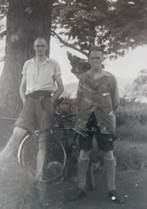
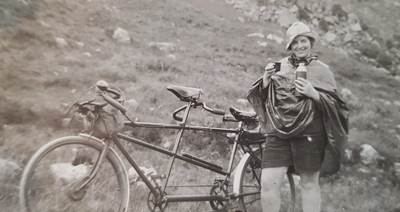
Another serious influence on my
whole life was my parents interest in cycling. They
had met on a Cyclist Touring Club ride.
My Dad had been taken out riding by his Uncle Oswald, and soon it became
his main interest, besides photography and later model yacht building and
racing. Mum and he went to Scotland on their tandem for their honeymoon. One story they told was while in a very
tranquil area, they saw two people walking towards them, and the breeze carried
their conversation to Mum and Dad, "Oh look at this tall thin man and this
short fat woman". Then shortly as they passed
they made polite conversation, and then chuckled to themselves afterwards. I
think it was a fairly truthful comment anyway.
Initially I was taken out in a ‘Watsonian’ sidecar attached to Dads bike, which I don't
remember, but as soon as I was old enough I took over the back seat of the
tandem, with a chain and
special cranks raised to reach my short legs. There was another
girl in the CTC Club called Christine Hargrieves that
had similar pedals on a tandem, and we could talk together as we rode home. I
do have good memories of the tandem, and specially an all
night club ride to Shrewsbury when they were worried that I might fall
asleep, but I really enjoyed it and specially the stop during the early
hours of the morning at the cross in the town for a snack and coffee from a
flask. I now know that this is at Meriden, and an annual memorial ride is still
enacted there. Mum had a black Raleigh
shopping bike initially and then a lightweight Hill Special ladies frame. I
also remember my Dad and I having a tandem tour on our own, again to Wales,
when Steve must have been a baby, and as the Elan Valley was being filled as a
reservoir, and we could see the church steeple and the roofs of the odd house
under the rising water. One night we slept in a hay barn and got milk from the
farmer for our breakfast. The smell of new hay still conjures up the cosy feeling of that night, and the strangeness of our bed
and accommodation.
TEENAGER.
Toy trains had always been part of
Christmas, and I suspect that I had an 'O' Gauge Hornby green four wheeled wind
up with a circle of track, though the first engine I do remember was maroon,
and had 6 wheels and two controls sticking from the cab, one to stop and go,
and one to reverse. I know I had a collection of track, buffers and points, and
I made a wooden tunnel made of curved thin plywood, and painted green
After the war, Dad bought me a
smaller scale '00' set, once again a shunter, 060 black, and the tinplate oval
of track just fitted on the extended dining table with a little room round the
edge. This was electric of course, with a black controller, and pieces of track
that automatically uncoupled the wagons if you were skilful
enough to stop in the right place. Electrical controlled points were available,
but I never put the track on a permanent base, preferring to change the track
formation regularly. It would reach right through the living room from the
kitchen into the hallway. I was definitely at secondary school by the time this
arrived for Christmas. and for several years I built up a vast array of points
and accessories.
Meccano too was a favourite, and back then the sets were arranged so that
they could be built up by adding the relative 'a' set. Set one came with a
booklet of models that could be built with those parts, and then buying set
'1a' it became set 2 with another book of larger models. Every Christmas, and
possibly birthdays too I got a new addition until I had set 6, and quite
impressive models could be constructed, cranes, lorries trucks and even a steam
engine. I also had the remains of my Dad's old set
from when he was a boy, some of it quite rusty, but with big girders, and
lovely brass gearwheels. I had a 'No 2' windup motor so that some models could
be given action. I spent hours building models, my favourites
being the huge articulated trucks with real steering. I could back a trailer
very well at an early age.
Another toy which I bought with my
own money was 'Castos', a set of wooden formers that
could be tacked temporarily onto a plastic covered cork board, and the
resulting shapes could be cast in plaster of paris
that you could buy at the chemist shop. The flat sections were then fixed
together to make buildings,
It was quite a messy business but good fun, and quite big models
too.
Bayco, another building set was plastic,
A set of baseboards with equally spaced small holes. Into these were inserted
steel rods of varying lengths, and between the rods slid plastic plates with
grooves down each side. The plates were brick pattern, green or white, or
corner pieces, or windows and
doors with blue frames. There was not much variation in the
designs, and not much scope for experiment, as the roof pieces were already
formed to a set size..
Earlier, Roy across the road had a
set of Minibrix, small rubber dark red building bricks
which clicked together very much like today’s Lego, but they made a pleasing click as they
separated. We did not make many buildings, but enjoyed making great lengths
stung together.
Early Bikes.
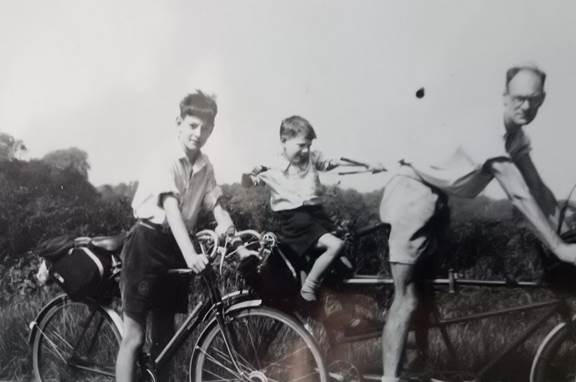
My first bike apart from a kiddy's
tricycle, was a black 'Wardley' with upright bars and
roller brakes, the only type available after the war. This was just for locally
going to the shops or playing in the road. I'm not sure when I got too big for
the tandem, maybe aged 10 or 11, as Steve could perhaps have gone on the tandem
then, but I began to want my own 'proper' bike for club runs. I had a terrible decision to take, as
Dad said he would pay half, but how could I pay my half
? He suggested that I could sell
my own model sailboat Trix, that he had built for me,
but I found that to be unthinkable. It worked out that I would pass on
ownership of all my Hornby Dublo trains to my young brother instead of
him having a new one. I'm sure this was a happy compromise from my angle,
though I never asked at the time what Steve felt about it, and I'm sure that I
was still buying new points at 3 shillings and ninepence each.
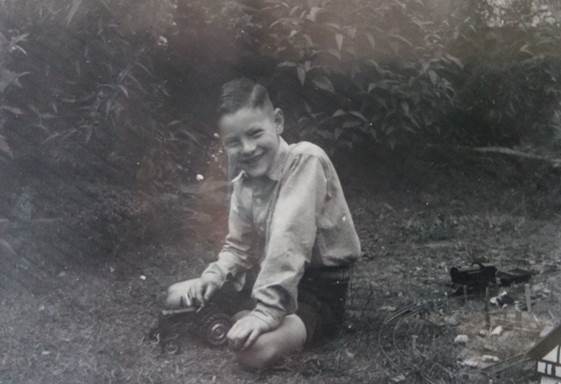
I did however get my new bike, a
bright green Raleigh Lenton Sports. Though it came
with a sturmey archer three speed, and a dynohub in the front wheel, dropped bars and cable brakes,
it seemed to me the perfect bike, and the pride I felt riding it is
brought back to me whenever I see something with that same unusual green colour. I don't know how old I was ,
but probably I'd guess around 10. I think I was only 13 or 14 when I went on my
first tour with Roy Hubbard who lived at number 10 and who Dad had introduced
to riding, and another young club rider called Alan Pierce, but nicknamed
'Quarter pint' as he was very small indeed and we already had a young lad
nicknamed 'Half Pint'. We went to the Wye Valley,
using Youth Hostels. Must look up my old YHA cards.
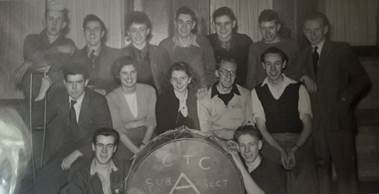
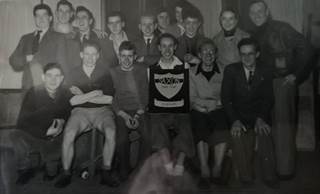
As I got older, I left the slow
'loiterers' section and rode with the 'intermediates' and then the 'A'
sections. These riders tended to be
considerably older than I was and usually nearer 20 or more. Later still the
Saxon Road Club was formed to enable some of them, and me, to race in time
trials.
As a child I guess I had weekly spends, probably a penny or two, but as soon as I reached
the grand age of 11 and left primary school I rushed off to be a paper boy
at the local newsagents. To begin with I did a round only in the evenings, just
over an hour most days, delivering the Manchester News, and The Chronicle,
together with assorted magazines on certain days. Some days the bag was so heavy I had to take
it in two sections. I was very quick to realise the
value of 'doing a good job', and it was soon clear which boys could be relied
on and who regularly did not turn up. I vowed to be the best ever, and quickly
got to know all the rounds so that I could be filled in with an extra round if
someone failed to show, which of course gained extra cash, but I was always
very eager to finish by 6.45pm when Dick Barton, Special Agent was on the radio
for 15 minutes. It was always so exciting that I hated to miss even a few
minutes, he was always in such an awful predicament as each episode finished.
I think I must have earned about
eight shillings a week, because at one stage I could just buy two points for my
Hornby OO railway at three shillings and ninepence each, and still have a few
pence left for cycle lamp batteries and the like. I had miles of railway track.
Later on I did morning round as well, not so pleasant
on cold dark mornings, but when it came round to Christmas the 'tips' were
fantastic. We always told Mr Armit
how much we collected, and he confided in me that I always did best,
"That's because they know you're always on time and polite when they see
you." He could have said that to all the lads, but I don’t think so. There were never any
paper girls by the way, though I never considered that to be unusual. I always
enjoyed papers, sometimes using my old black bike to 'scoot' round on. I also
stripped down the Wardle, no mudguards etc, and
fitted a front cable brake and fixed wheel, because I got quite skilled at
riding it backwards in a circle. I wanted a unicycle like the clowns at Belle
Vue Circus at Christmas, but they were not available then.
I don't know when sweet rationing
ended, but I do remember the day, because all the boys were allowed a pound
(weight) of any sweets we chose, a massive amount then, when even buying an
ounce from a jar was
quite acceptable. There were probably
about ten regular paper boys. I was genuinely
upset when I had to give up my rounds, but in the year
I was to take my GCE, Dad made me give it up so that I could study more,
though I had always done my homeworks without much
prompting, he knew I was not an easy learner.
He did give me 'an allowance' though which was not quite up to the
earnings I had been bringing in.
I did have other work to earn cash.
During the school holidays Dad got me a job on his ex managers farm, in Leigh, cutting cabbages, pulling
spring onions and making up bunches, making up boxes of lettuce ready for
market and such jobs. I think it must
have been more of a smallholding, though they did grow crops too. I rode there
daily on my bike, passing over the Manchester Ship Canal on Barton Bridge, a
lifting road bridge. Once on the farm,
we were cutting corn, with a tractor and cutter. Normally I followed behind
collecting the 'stooks' like a bunch of straw, and stacking them in groups of
five or so around the field, to be collected later when they had dried, to make
straw stacks. On one occasion, when I think the crop was beaten down with
heavy rain, the tractor driver was needed to walk with the cutter to encourage
the stalks into the blade with a rake. I
was told to drive the tractor ! It's easy he said, and he showed me the
clutch which I just had to let out to move forward or push in to stop. I had
NEVER in my life driven anything bigger than a pedal car or Meccano model , and round the edge of the field and on the sharp
corners I did pretty well and was feeling rather grand. But, as we got to the
middle of the field, the corners got sharper, so that the steering lock would
not turn quickly enough. "Just back
up a bit and take it again" was shouted in my direction. I knew how to
back, but had never driven with clutch and brake before. I think lads who grew up on farms drove
tractors from a very early age, but they forgot that I was not one of
them. Reverse gear was engaged and back I went... But did not stop quickly
enough and broke the thick wooden beam that joined the tractor to the cutter.
"Oh that's buggered it" said Mr Alf Hodgekiss. Oh Boy did I fee
bad.
Other work was Christmas Post,
during college holidays, and also while I was still at school
I used to work at Oldhams Batteries in the holidays.
I enjoyed this too, very practical and I felt really grown up. I became known
to the personnel manager, and he sent me all round the factory to all the
departments, so that eventually I could slot in almost anywhere. It was not
very demanding work, though at times heavy. Casting battery plates, using molten lead and
stacking them in heavy trolleys, or the battery posts as they came out of the moulding plate, checking them and counting them out in
100's. Using a template and roller to paint the name on the side of the boxes,
or on the assembly line, mainly a woman’s job, filling in the tops with liquid tar. The
hardest job was supplying the tar boiler using 40 gallon drums of solid tar. Each
drum was very heavy, needing to be rolled in from the yard, and then the drum
had to be cut open with an axe, and the solid tar chopped into small enough
pieces to go into the boiler. I did not enjoy that job at all. Another bad job
was in the acid vats where I think parts were being plated. Working in
this department we got a pint of mi k for morning and afternoon break, so I
guess that was not a healthy job either. Oldhams
money was very good for me, though I suspect the full time
chaps were not well paid. Most of the work was extremely repetitive and boredom
was my biggest worry. When stacking the plates, I learned my 14 times tables,
knowing immediately how many I had in the truck. One chap spent every day at
the same machine with
sacks on each hand checking parts as they came out of the machine. He virtually
had nothing to do at all, except guide the bits into the box, and I asked
him one day what he thought about all the time. He surprised me by giving such
a long list, from which horse to bet on, through what he would eat that night , to where he would go fishing on Sunday. He was obviously
far away from his work in his mind. I knew I could never take on that sort of
work. I got much more adult here. Blokes
would show me clever drawings of lewd acts, and the women on the assembly lines
were always telling dirty jokes or making lewd comments, and of course the
general level of language was way below my normal level, swearing and cursing
being the norm. I never ever heard Mum
or Dad swear.
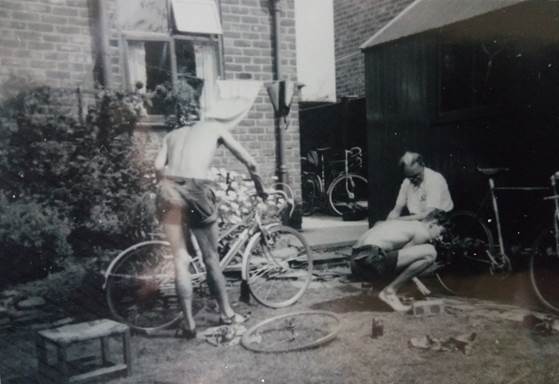
Most of my cash later went on my bikes, spare
light wheels, special racing tubular tyres, Youth
Hostel weekends, race entry fees, and normal weekend rides. We all used to take
sandwiches and stop at lots of different cafe venues for 'dinner stop' where we
would order, '5 meals and 12 tea only'. The affluent
ones, who were at work, bought the cooked meals, and the rest would get a huge
pot of tea between us, while we ate our own sandwiches. If the ride was to
Chester, we went to 'The Dungeons', that served the best fish, or pie and chips
ever, so most of us would save for the meal there.
The various sections of the club met
at East Didsbury Bus station, (EDS) on Sunday
mornings, around 9.00am, possibly 60 or 70 in all. We sometimes had a printed runs list, and went off
in groups. In the racing season, it was different in that races had to start as
early as 6am to finish before the traffic got on the roads. After a race we
would rush off to meet our club section wherever they were having the dinner
stop. Lots of times the favourite stop was a cafe at Goostrey, a huge cafe where as many as 200 cyclists would
gather to eat or just talk.
Active cycling and its associated
social life filled almost every waking moment. I never had a tennis racket like
other kids, or thought about cricket or football. I was made to play rugby at
grammar school and as I was so tall I had to play on
the school team. I could have been on the first team but usually made the
second team as I often refused to play on a Saturday if I had an
important time trial the following day. In the sixth form the PE master used to
chastise me, "All this cycling will do you no good on your teacher job
applications, but first team rugby would be an additional good point in any
school." He did not convince me.
I still have my diaries for 1952,
'53 and '54. nothing very world shattering is written there, but they give a
good insight into what was in my mind at the time.
MY DAD'S FAMILY.
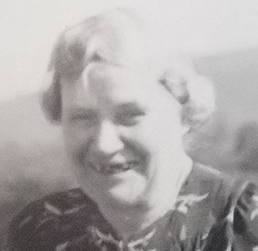
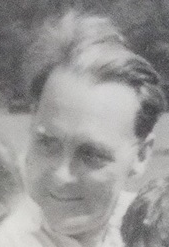
As a young boy, my favourite aunty was Nellie, and an uncle Oswald, though not
man and wife, in Dad's
family
To start at the beginning.
My Dad was Thomas David, and his dad
was too. The story was that the eldest child in each generation had always been
a Thomas David, rather confusing. I broke the mould
because Thomas was not a fashionable name in my generation, and I had never
particularly liked it, and I had always been called David anyway, as was my
father. I called my son Trevor David, which at least kept the traditional initials , and I have a very good college friend called
Trevor Scott who became my son's godfather.
I never knew my Dad's father as he
died quite young after
a life plagued with stomach ulcers, when Dad was about 20 I guess. He was an
accountant by profession, and worked for a company called J&T Peters,
farmers and wholesale vegetable merchants.
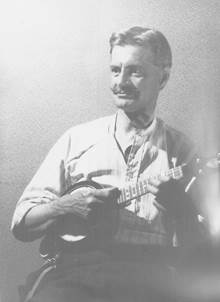
I believe he was a very quiet
individual, and he played a ukelele-banjo, which I
still have. My Dad could play
'Little Brown Jug' on it, but nothing else. His Dad also painted
as a hobby and we had one picture of his at the bottom of our 19 Repton stairs
for a long time, it
had a sailboat with brown sails.
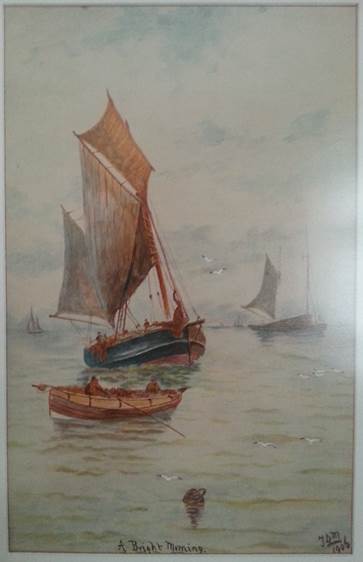
Dad said he could remember his dad
bringing home small pots of a new water colour as a
surprise, and the smell of the small white ceramic pot of Windsor and Newton
water paint still reminded him of his dad. They initially lived in Romily and once when we passed the cottage while cycling,
Dad pointed it out to me, though he said it had changed. Later they moved to
Leigh, as the train journey from Romily to Glazebury each day was too far to travel. Dad remembered
being allowed to run down the hill from their house to Romily
Station on his own to meet his Dad's train in the
evening.
Dad had at least three uncles, his Dads brothers. Oswald was the only one I knew. Their father
was a builder in Gorton, and had quite a large business I believe. He is buried
in a cemetary in Hazel Grove, which I once tried to
find but could not. The church is still there but all the records are kept in
Chester I believe. He built two big
churches in Gorton, and lots of houses too. During my life Oswald lived in one
of these, the family house, with his sister Clara, the only girl in the family.
They owned several terraced houses in the same block that were rented out.
Neither Oswald or Clara married. When I was very young theirs was always the
most expensive Christmas present I received. One was a
small German Schuco clockwork car with three forward
and a reverse gear, and a stiff wire sticking out of the roof with a steering
wheel on the end of it. I have since seen one of these in a toy museum, a true collectors item. Another present
was a real steam engine that had wheels and a steerable roller on the
front. It was he who started Dad cycling
with the CTC where he then met Mum, so I suppose I owe my existence to him ! He took Dad on
a cycle tour of Switzerland, when foreign touring was really in its infancy.
I have seen Dad's photos taken on this tour, and a painting or two of
his. I don't remember Oswald riding with
the club, though I do know that he passed his bike over to Stephen when Steve
got old enough to ride his own on club rides. Oswald then owned a motorbike, a
special one with a quiet water radiator cooled engine. Oswald lived on his own a long time after
Clara died, becoming very frail, and living with us for a while before he had
to go into Cheetham Hill hospital where he died.
I believe that Oswald and is two
brothers went to Africa as teenagers. Clara got Oswald to come back by some
subterfuge, and the one of them went on to Australia, leaving Dad' dad on is own, so he came back too. The Australian one settled
down there and married an English girl. Their daughter became Billie West,
mother of Gifford and Leonard, my cousins, and my age, who have both visited us
in England, and I have visited them.
Dad's mother was called Annie Haig and she had two
sisters, Polly and Nellie. both of whom I knew as a child and visited
occasionally in Gorton where they all lived. Polly had two daughters Evelyn and
Elsie. Incidentally it was Elsie who was
instrumental in me obtaining my first Hornby Dublo
train set when they were still almost unobtainable after the war. She
worked in a big Manchester store and was able to buy one as soon as the Christmas
stocks came in. Evelyn had two boys, Peter and Geoffry
about the same age as Steve, and they lived in the house opposite Auntie Nellie
When my Grandfather
died, Dad's mother fell into a deep depression, would not speak to anyone, go
out of the house or do anything towards day to day living. She was eventually
taken into an asylum, in Warrington, never to come out. I did visit her once. I was told that she
would not believe Dad was married, or that I was his son. I only remember an
old lady in an institution place, but I know Dad and Mum had discussions about
bringing her out to live with us, but the doctors
advice was that the world had changed so much that she would not be able to
cope with busses or traffic or shopping, and it would not be advisable.
I don’t even
remember her dying, or talk of a funeral though my parents did visit her, a
long bus and train journey away from Denton.
Auntie Nellie however became Dad's
stand -in mother. Dad lived with her and when Mum and he married they both
lived there for a short time until their new house (19 Repton Avenue, Denton)
was built, very soon after I was born, though I believe she came out of
hospital with me to auntie Nellie’s house, 42 Woodhouse St. Uncle
Tom Wood, her husband was never at home. At the time of the great depression he had to find work in London, and only came home
on occasions, and I only saw him once or twice ever, though we visited her very
often, and she came to our house too. Polly was also married but I don’t
remember seeing him at all. Auntie Nellie was a real laughing lady, always
pulling little jokes on people around her, hiding Toms pipe tobacco, or his
pipe, and bursting out laughing as she told how he searched for it, and all with a
real twinkle in her eye. I was very impressed later as a boy when she took
apart the woodwork of an upright piano and made a very presentable cupboard
from it. It was she who introduced me to
my first banana, though I have only heard this from my parents. It seems that
during and after the war, all foreign fruit was unobtainable, but I think that
maybe her husband worked at London Docks, and managed to buy a couple of
bananas from a boat that came in from the Canary Islands. He brought them home
with him as a gift, and she brought one round for me. They tell me that I did
not like it !
We took auntie Nellie on holiday once, to Whitby, and she had a small heart
attack while we sat on the beach. I was still too young to understand anything
except my parents concern. Her house 42 Woodhouse St. Gorton,
was second along a small terrace, with a back yard, and an outside toilet, the
back door lead into a small kitchen, and then to the living room where there
was a huge blacked iron fireplace with an oven and high mantelpiece. There was
a front room, never used to my knowledge, and between the two were the stairs,
though I have no recollection of going upstairs. The toilet was outside
the kitchen door in the entrance yard.
Lighting was by gas mantel and I used to like watching as it was lit.
Outside the back gate, there was an area of unfinished earth between the backs
of her row terrace and the next road terrace. This was the common yard where
everyone hung out their washing. Evelyn lived across this yard in the next
road, and Elsie lived in Nellie’s road just opposite her.
Auntie Nellie had one son, about Dads age I guess, called Sydney and he married Lena. I suspect that he married before Dad, as in
my memory, he was never living with his mother. He was an insurance agent
working for the Co-operative Society in a big building in Manchester, and they
had no children. I always felt that they thought themselves a bit superior,
they spoke differently
to the rest of us, she smoked using a long holder, always had
painted nails and jewellery, and their house, no bigger
of better than ours always looked brand new, with immaculate furniture that you
were afraid to sit on. We did not often visit them, but they always came to us
for a meal on Boxing Day, with Nellie and Oswald there too, so it was quite an
occasion. He had a peculiar laugh, more like a titter, as if he was afraid to
laugh out loud, and spoke as though he had loose dentures. He smoked too, so
the next day it was all windows open, and once he put a smoking cigarette in
the funnel of my clockwork train and Dad said afterwards that he thought that
was awful, "Fancy putting his smelly cigarette in David's new engine !" I thought it was a good idea
! We played cards sometimes or other board games. and Dad and Sydney
played chess. One unusual board game came from Billy and West, the Australian
relatives, 'Race around Australia‘, with
pictures of the wild life which I enjoyed.
Dad told me once that Sydney had a car when he was a young man, and one
day it refused to start as he was winding the starting handle, so he got mad
and threw the handle at the car, bursting the radiator and spraying himself
with water.
To get to auntie Nellie's house was a walk to
the bus, a short ride, and another walk down Tanyard Brow, close to Dads work yard. Mostly though we would walk all the way,
through Debdale Park, past the reservoirs, and the
allotments, which was all very pleasant, and about 3 miles. We often went by
bicycle of course, straight round Thornley Park and down Hyde
road, turn right at Tan yard brow, Just under the railway bridge where
Dad's yard was.
Dad wanted to become a merchant
ship's radio engineer, as he was very interested in radio. He made for me a
'cats whisker radio' that had earphones and was tuned by moving a small wire on
to different parts of the chrystal, which looked just
like a lump of coke. I was far too young to understand it at all. Dad's father would not let him follow his own
idea, but got him job
where he worked in an office in Glazebury near Warrington, and he trained as an accountant,
like his father.
Later as lorries took over from
horse and cart transport, he
became a driver in addition to his book keeping, and worked at a
branch in Gorton that bought potatoes wholesale from Cheshire farms and sold to
chip shops and greengrocers all around Manchester. A couple of times I was with him when he
delivered to a work's restaurant in Beyer Garrett’s Engineering in Gorton where they had
huge machines. I was very impressed looking down on a massive workshop floor with
men standing on the machines as they revolved or moved along making heavy parts for steam engines of all kinds. Now I know that Beyer Garrett Engines
were world famous and used far and wide in the British Empire, and are even
still in use today in Africa and India.
Often I would go out to work for the day
with him, having to almost run to keep up with him as he walked to his yard. He
always dressed in a navy blue one piece boiler suit,
sometimes with a leather waistcoat over it, and always with a thin leather belt
loosely around his waist, and leather sandalls. He
took with him each day a 'brew' in an white enamelled can with a top that had a handle and served as a
cup. The tealeaves and sugar were inside dry, and he would ask one of his
customers around dinner time to give him the boiling water. His sandwiches were
in a tin, favourites were cheese and beetroot, or corned
beef, and usually a piece of Mum's cake.
If we were in a built up area, we would find a quiet
corner somewhere, or sometimes drop in on auntie Nellie for a chat. The best trips out were to the farms to
collect the produce, almost always potatoes, but during the fruit season
sometimes boxes of pears and very occasionally apples. On these days out we
would eat in the farmyard, or in a quiet field along the lanes. One occasion
I remember, for no special reason, he took his paints in a special box he
had made, and we sat overlooking a small valley and the roofs of a farm, and he
drew and colour washed the painting. In the box he
had a wooden frame over which he would pre-stretch the paper so it did not
wrinkle with the wet watercolour.
On the way home I often went to
sleep, the drone of the engine the special smell of the cab, and the motion
were very soporific. On these trips he explained the working of gears and
engines and clutches. One night we were late getting back and he was very
worried that the police might stop him as his lights weren't working
properly. On a few occasions when the
season was right we would go a long way to Lincoln for
some special 'early' potatoes, small and with an exquisite taste. He knew the names of all the potato varieties
and he had done coloured sketches of them all in his
sketchbook. Mum used to enjoy joining
him on the special longer trips out.
The Gorton branch of J&T Peters,
initially, a manager and two drivers, but later Dad took over the managers job as well as driving and book-keeping. I well
remember once that he came home in a furious temper, something unheard of in my
Dad. It seemed that when he took over the running of
the branch, he had been given a promise of a bonus for any extra business he
could bring in. Dad worked very hard and almost doubled the trade in his first
year, but when he presented the annual accounts to Mr
John Peters, he was refused the promised bonus because it would have
put Dads annual pay above any other company employee. He called it robbery, and he hated John
Peters ever after, again a very unusual for my forgiving and peace
loving Dad. Much later, when he got to about 55 I think, he quit his
managers job at 'Peters'
, and took up a purely driving job for another rival fruit and vegetable
wholesaler just a little further down Hyde Road in Gorton. He was so well known
by his customers, that they stayed with him, and he was quite pleased to have ‘given Peters a bit of their own
medicine’. He got the
same money with no additional worries and was very happy there. One of Dad's
tales from that time....The owner manager used to organise the loading of the several delivery trucks each
morning. He held the lists of produce for each truck, and shouted out to each
driver in turn, which item he should load up. As soon as each item was loaded,
the driver had to shout 'Next' and he would be told the next item required. Dad
deliberately waited a few seconds after loading an item, knowing that his
manager would say, "Shout next David", thus giving Dad a bit of a
chuckle, and that saying always still comes to mind when I have finished doing
a chore and wondering what to do next.
Dad had several hobbies. His cycling
of course, every Sunday a ride, specially during the
summer months. The bikes were in a shed
to begin with , the tandem was always kept there, with
my mice in several cages, and a bench
where I 'made things', but very soon the
bikes were brought to live in the hallway behind the front door. Eventually
there must have been 7 or 8 kept there, leaning on the cupboard under the
stairs, with one hanging up I
think. Cleaning bikes was
always an important activity, and for this they were often brought into the
living room and cleaned on a special rug kept for the purpose. Behind the
settee the whole wall was covered in glass fronted book cases, full of old
books that I guess must have been his Dad's books. I
know Mum wanted to get rid of them and I'm not sure where they went, but by the
time I was a
teenager, there was only one bookcase left in the alcove between the fireplace
and the front window. Even that disappeared while I was at college and the Hi Fi radio and record player took over that space. When I lived at home there was no television
of course. There was Murphy radio that had lots
of wavebands and made electronic whistles and buzzes as you twiddled the dials
which I liked to do. We always used to
listen to 'Saturday Night Theatre', as a family, with me making a Meccano model
on the dining table while listening. Also there was
'Children's Hour' from 5 til 6 I think, and most
women tuned in to 'Womans Hour' during the afternoon.
'Family Favourites' was on Sunday lunchtime I think,
an Armed Forces request time. Dad loved latin-american music, Saturday morning was Edmundo Ross, and a singer
and film star Carmen Miranda from Brazil was a favourite
of his. Later I loved ‘Dick Barton,
Special Agent‘.
Then there was photography, not long
out of its early beginnings really. His first camera I remember used big glass
plates for the negatives. He had to clip the plate in a case onto the back of
the camera, and then pull out a piece of black paper, before he took a photo.
He had then to take all these cases into a dark room. This was our bathroom,
where he had made a special frame to fix at the window with thick black cloth
over it, and with a red light so that he could see what he was doing. The glass
plates were fitted into a rack which was then immersed in a chemical liquid, at
a certain temperature for
certain time, both really important. Then they were washed in the
same container with water. This gave him the negatives. From these he had to
develop the prints on paper. Sometimes he made 'contact prints', the same size
as the glass, or he had a huge enlarger with a big black paper bellows and
large lenses 6 or 7 inches in diameter, and an electric bulb that gave out a
lot of heat. His friend Louis Heap had a more modern enlarger
, held vertical on a stand which he borrowed once. The prints also had
to be developed and then fixed in different chemical and then washed. He used
to wash them with the bath full of water. Mum complained once when his
chemicals made some marks on the enamel bath. She also used to bemoan the fact
that he would only take scenes, and hardly ever took pictures of people. I used to love watching the picture slowly
come darker in the tray. He had a stop watch and thermometers and all sorts of
special equipment. He even had special
'tints' that he used to paint some colour to the
black and white photographs. What a difference from today’s 'one hour prints' on every street.
His painting too changed as I grew
older. To begin with he only used water colours, in a
sketchbook, or on sheets of cartridge paper specially stretched over a wooden
frame. Much later he took up oil painting and did much bigger paintings. I
really only saw him using water colours, from a box
he had made. he seemed as if he painted the picture and then almost washed it
off, and then painted it over again. He called it laying on the colours to give it depth. He also used to look at his pictures upside down for days at a time, "to get the
composition right", so he said. His
Dad had painted, though not much, and he had no formal teaching to get him
started. I think it was as I became a
teenager that he took a course of painting at Salford Tech, and there he learned
about perspective and shadows and other technicalities of composition. I was
very admiring of all the drawings he brought home, including life drawing with
models, plants and everyday objects. He used to go out on his bike at nights
with a big drawing board strapped to his back, and his folder. He had a big
easel, which he never used, but generally he painted while sitting on the
carpet or rug, no table or chair or anything.
MUMS FAMILY.
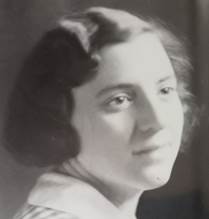
In fact 'Kitty' was always to me,
"me Mam", and it was only later that Julie persuaded me that mum or
mother was better than Mam !
Born in Congleton
Cheshire as Kathleen Axson, in 1910, she had an elder
sister who died I think at the age of eight. Mum said that they had both
watched an exhumation in the local cemetery, and her sister soon after became
very ill and very quickly died. Her
mother too died while they were still very young and her father was soon
enlisted into the '14 -18 war. She and her sister were taken to live with her
granny and grandfather on their small farm nearby. She had many stories to tell
of her life on the farm which she enjoyed very much. They never had money, but
there were always chickens , eggs, potatoes milk and
such basics. Close to the canal at Buglawton she and her sister often hitched a ride on a
passing barge and walked back. Her
grandfather was always drunk and never did any work so Granny ran everything.
He used to come home in the evening very drunk and hostile, so they would lock
themselves in their room. He never touched them but he knocked her granny
about. Mum used to drive a cow to market with him, and her grandad used to stay
in town and drink all the proceeds When he finally died it was found that
they had no money and were in debt so the farm was sold and they went to live
in Levenshulme with an auntie, strangely enough in
Moseley Road next to a railway bridge.
There were several aunties living there, Aggie and Annie and money was
very short. Aggie never married and later ran a shoe shop in Leigh, which
I visited, and later lived I Congleton. Another auntie later served in a posh
Manchester dress shop. Mum was sent to
work in a grocers shop 'Seymour Meads' nearby, and she
really enjoyed the work. Earlier on when still in Congleton
her granny had got her a job in an ironmongers shop,
and she enjoyed that too, but it was found out that she was under age and she
was sent back to school. She was always top of the class at school and loved
it, but her granny was keen to get her working and earning.
Mum lived with her aunties until she began cycling and
met Dad, neither of which did her auntie
approve. It was of course considered
very unladylike to ride a bicycle, to say nothing of wearing trousers or
shorts. One day when she came home from
a Sunday bike ride, her auntie refused to let her into the house, and threw all
her belongings out of the bedroom window. She went straight to Auntie Nellie’s where Dad was living after his Mother was moved to the asylum.
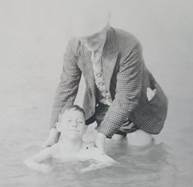
What of her father
? Well, he came back from the
war, and found another girlfriend, who he married and they had three children
Mum's step sisters and brother. Her granny of course did not approve of the new
wife, and used to tell her to run away if ever they saw him in town. Mum said
that she did not really know what it was all about at the time, but later realised that it must have been very hurtful to him. I did not meet him until one day when I was
about 6 or 7, he turned up at 19 Repton with his son Guy who worked with him
driving one of his furniture removal vans. Mum was flabbergasted, specially when he gave me a half crown which was quite a
large coin then. They had always known about him and his family and business through
auntie Aggie, but after that occasion they became closer. He had a son Guy,
about ten years older than me, and when we visited, I could play with his old
Meccano set, and it was passed on to me later.
He also had two daughters Pat and Eileen, older than Guy I think, both
of whom joined the forces during the second world war. I can remember feeling
envious of Pat who drove huge army lorries, and once came to our house in
uniform. Eileen visited once and
brought me a present of a small story book about a horse or donkey called
'Plonk'. With it was an egg cup made of turned oak with a painted picture of
'plonk’ on the side. That egg cup is still in the kitchen cupboard at Carbis
Bay. I was only 6 or so at the time.
Later, we visited at Congleton and stayed the
night. I know the house well even now. Then it seemed to have a huge long garden
beautifully kept with vegetables in neat rows, and a greenhouse at the bottom,
and cold frames. I could pick and eat the peas too. Beyond the garden were
massive elm trees full of rooks that made a real noise morning and evening. The
river was out of sight but just a few hundred yards away below the trees. Pat lived there with her husband and father
when I grew up. Her husband was Stan and he collected stamps so much later I
used to send him lots of them from Grand Turk.
Guy eventually took over the house
removal business and they had a big yard in Congleton
with several big vans. The company is still there, run by Guy's sons. Pat died after living alone for years. She
has one son..
Eileen went to live in Tasmania and
her husband was a forestry worker there. They visited England once and I went
to collect them from Basingstoke in our Bedford van, where they were visiting
friends of theirs, and they had a meal with us in Fleet.
TEENAGE YEARS
I must have still been riding on the
back of the tandem when I was 10 and 11, because I contracted Pleurisy in the year I was to take my 11+ examination which decided what
type of secondary school you could attend. Plaurisy
is a chest infection a bit like TB, I gather, quite serious, and I had always
been a bit of a sickly child, lots of coughs and colds. Why I connect these two facts is that I can
remember being on the back of the tandem on a Sunday ride, and I got
severe pains in my chest, so that it was really painful if we went over a bump
or rough ground, and if I breathed in, the pain was excruciating. This
kept me off school for several weeks and in the examination year this was quite
important. The primary school teachers did not think that I had any chance of
passing anyway, but my parents insisted that I should sit for them all. Four
possibilities, Manchester Grammar School was the tops, all their pupils got in
to Oxford or Cambridge. Second was Hulme Grammar, then Audenshaw, and fourth
was Ardwick Central where Dad had gone, and Audrey went there too. If you
failed these you went to the Secondary school in Denton. In fact
I passed for Hulme grammar, the second best, but only as a fee payer and we did
not want that. I also passed for Audenshaw which was much closer to us anyway,
so I ended up going there, lucky fairy at work I
think.
GRAMMAR SCHOOL
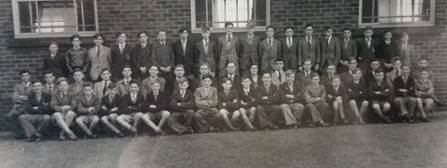
At Audenshaw Grammar School, I began
with languages and sciences, all of which confounded me. Grammar school
education was for the brainy half of the population, lectures more than
teaching, and I was not brainy at all. I was useless at the general science in
the first year, so I was put into a languages timetable from second year on.
Languages too, completely baffled me. I was given French and German lessons. I
loved the German teacher, and the lessons too, but though I knew all the
vocabulary, I had no idea about tenses and declinations, even in the English
language, and there was no importance attached to speaking in the examination
course. Marks were deducted for any
grammatical errors, and so I was always getting really low marks though I
always got top marks for
all homework 'Vocab' tests. As I was in that section of the
school timetable, I also was supposed to take Latin or Greek, and for some
reason it was Greek for me. Once again I enjoyed the
alphabet, and the stories we translated were great, but again the grammar of it
all had me completely baffled.
Eventually I struggled to initially pass in only 4 subjects at General
Certificate of Education. I was not entered for German as I only got 4% in the mock ! I was then taken in hand by my form tutor Mark Gibbs,
the best teacher anyone could ever have, and he personally coached me to pass
American History for my 5th pass in the November re-sits. I now had the
required 5 'O' levels required for entry into a teacher training college. I was
doing my best, but it was no walkover. It was Mr
Gibbs who arranged a special timetable for me in my sixth form years. I then
spent 22 periods of the
40 period week in the woodwork room, in fact becoming a young
assistant in there, helping Mr Eastwood with
sharpening the tools and sometimes even looking after the younger classes. By
then I had decided to become a woodwork teacher, a decision that I never
regretted.
In my first week, at the Grammar
School, the science teacher was calling out in turn, the names of the pupils
from his register.
"Moseley". I stood up
to be recognised. "Are you related to the Oswald
Moseley ?".
I replied of course that I did have an uncle called Oswald. Some of the
pupils, and he too of course, were well aware of a well
known political figure of the time, Sir Oswald Mosley, who was rather an
outspoken politician, but I was far too immature to have heard of him. "Ah
well, you will be called Siroz", and after that
day he always called me that. Other friends of course shortened it to Oz and
that was my nickname throughout school. I loved this teacher, Bill Fradley, who
taught PE, and
wore a lead bracelet round each wrist to build up his muscles. He wore really
flash ties, and boasted that he had a different one for every day of the year.
I went on a group school holiday with him to the Isle of Man, supposedly we were
to camp, but the weather was so bad, we spent the week sleeping in a school
hall o9n the floor. I enjoyed the holiday but was quite homesick, not really
having any special friends with me, and the first time away from home. I saw a
factory where they were gutting herrings in machines and smoking them to make
kippers. I don’t think we had any arranged activities and we seemed to have
most of the time to ourselves. I booked to go on his school holiday the
following year, on the Norfolk Broads in a motor cruiser for 10. In fact it turned out that they could not get a big enough
boat, and at the last minute someone had to drop out. I volunteered because I
could go on a bike tour instead, and I went to Scotland.
Another time, probably in my second
year, as I filed out of assembly, the headmaster was standing at the door, and
motioned me to one side. "Could you stand outside my office please".
I did not think that I had done anything wrong but as I had never ever spoken
to him before I was apprehensive. When he was seated at his desk, and I
standing before him he looked me over and asked my name. "Moseley
Sir"…. "Well Moseley, would you pull up your socks." This I did,
but they were only short ones, just above the ankle. I was also wearing grey
shorts. After a short pause he said, "Well then Moseley, turn them down
again" , which I did. "Off you go then, and
by the way, have you thought about wearing long trousers ?".
I told Mum about this and she laughed and pointed out that I was probably
the tallest boy in my year, and that most pupils could not wait to get a pair
of long pants. Though I had not considered it, I was quite proud of being the
last one to be tortured by them dragging on my knees.
I don’t really remember the early
Woodwork lessons, but I guess I enjoyed them very much and must have been good
at it. When it came time to decide in which subjects to specialise,
it was Mr Gibbs who suggested my woodwork lesson
bias, as he knew that I spent every free moment at school, in the workshop,
with Mr Eastwood, nicknamed 'Chunky' for some reason.
I also liked art very much, Mr Darlington, who could
draw fantastic railway engines on the blackboard, and between these three
teachers I grew up from a boy to a youth.
I was very proud to be asked to make
a new lectern for
school prayers in the hall. Designed by Mr
Darlington, it was in mahogany and beech, massive pieces of material to work
on, with castors set into the curved base, a turned stem about 6 inches
diameter, and a top involving skewed dovetails.
I often wonder what happened to this. I visited the school in 1966, and
it was still there then. I also visited Mr Eastwood
retired at his home on this occasion.
In those days, there was no Woodwork
'A' level examination, but I took Art and English literature. I really enjoyed
all the art work, taking hours over my homeworks, but
I don’t think that
coursework was taken into consideration for the final grade. Anyway, I passed
in both of those, and also took woodwork as a City and Guilds examination which
was really a technical school qualification. I had to take the three parts of the exam at a
technical school, a bit un nerving, strange workshop, bench and tools, but I
came away with top marks.
After my special technical
timetable, the following year there were two other pupils who opted to do a
similar course, John Woolfendon and Peter Quine, 'Woolfie' and 'Quink', and they
both followed me on to Loughborough College too, but after their 'National
Service'. I was starting in my third year at college when they started their
first year. My first sight of
'Woolfi' was in the college refectory
one lunch time, and he called along the queue of students, "Hey,
Oz". I wasted absolutely no time in
telling him that I had left that name behind at School.
The school used to have an annual
theatrical production, on the stage, and usually it the Gilbert and Sullivan
operas that I remember. I was put in charge of scenery, a series of wood
framed, canvas covered 'flats' which were fastened together with cleats and
rope, to form walls, windows and doors, internal or external as the scene
required. Mostly the flats were re-painted for a new production but often, new
or special flats were needed. I did enjoy this, specially
the excitement of show nights when changing scenes behind the curtain and out
of sight of the audience, when everything had to be done on time and
efficiently. Mr Darlington was in charge of 'lighting'. One of
my school friends was Malcolm Cowdon, and he once was
the main character, a girl, in one play, and I did admire his courage and his
singing.
One teacher was Miss Loft, nickname Lucy, who taught
junior maths, and remembered for her 'good and bad
fairies' in equations. ( two plusses equal minus, etc) She asked if I
could put up some curtain rails at her house, and I did this and other small
things. Also I built some massive oak bookcases for Mr Gibbs over a whole wall of his home. Mr
Gibbs ran something called 'Periodicals for refugees' which entailed lots of
student volunteers staying on after school to wrap magazines in rolls of about five, and stick on address
labels. I did this regularly but have no idea now where they were sent.
There were of course 'prefects' and
of course I was one ! I only remember that the duties
were not very inspiring, ensuring single file on the stairs and corridors, and that
they kept me out of the workshops. I do remember in the first few years that I
had to wear the school cap on the journey to school, and that I used to put it
on as I approached the school gate where the prefects were on 'cap duty'.
Another incident had lifelong
consequences. I think, probably in the 4th year, we were having break one day
when 'Woolfie' a mate of mine, jumped onto my back
from the flight of steps as we exited the gym changing rooms. It was
unexpected, and we both fell to the ground, with me face first onto the hard
playground surface. I already had my front tooth chipped quite badly, from
young brother Steve kicking me accidentally but this took off another section,
and I then had to have a silver brace put on it. It was this that prompted
Julie's first words spoken to me. Later when I was at college, we were having a
PE lesson on the flat roof of the gym, normal in good weather, but the surface
was slippery, and as we did some sort of wrestling, rather like a rugby scum
but just with a partner, I again fell on my face and finally broke the whole
tooth off. Three times, breaking the same tooth, and all around the first week
of November. At 70, I still have the false stub screwed into the original root.
As usual, my school experiences were all happy, with no bad moments or memories at all.
NATIONAL SERVICE CALL-UP.
Julie and I got engaged on my
Birthday in May and in the Summer of 1954 we went on a bike tour holiday round
Cornwall, expecting this to be our last long time together as I was due to go
away on National Service in the Armed services, July or August at the latest.. When boys were
almost 18, the 'Call up' age, they were summoned for a medical inspection. In
my case, I had already been granted a place at Loughborough College to start in
September 1956 when I should have completed my National Service, and to make
sure that I finished in good time, I had applied for 'Accelerated call up', and
August was the latest that I could start in the Air Force, which I had put down
as my first choice, Army, Navy or Airforce.
I went to my medical on the appointed day,
probably before my 18th. The only thing I can remember about it was that I was expected to pee a sample into a
bottle, in a room with doctors and others. I found this quite impossible, and even when given
permission to use the toilet, I found it very difficult. I still find it
impossible to pee in a public latrine. Nothing more was heard of the Medical result, until Julie and I came in from our cycle
tour of Cornwall. "Has my call up date come through ?" was my immediate question to Mum. "Wait
until your father comes home", was her intruigingly
serious reply. Usually referred to as 'Dad', the use of father was reserved for
really serious matters. It appeared that
I had in fact FAILED my medical and, as a really fit and unusually active ‘teenager' this had given Mum and Dad some concern. They had enquired and been told that I had a
scarred eardrum, which could be damaged in future by close gunfire or flying in an un-pressurised aircraft, and so I had been rejected by Her
Majesty's Forces. I saw a private ear
specialist who confirmed the injury, and he advised me never to pressurise my ears in any way. My parents expected me to be upset and
worried over this turn of events, but I was elated. I had not looked forward to
wasting two years of my life 'square bashing' as it was known, and I had already
accepted the advice of Woolfie
and Quink as to my best course of action to relieve
the wasted two years. Number one was that I was bound to be chosen to ride my
bike for the Air Force Cycle Race team, which would take priority over other training. Number two advisory, was that I should take up playing a musical
instrument and try to join the band. This seemed a good idea, and I had always fancied playing
a saxaphone, and loved the music
of Billy May's Band with his sliding saxes.
MUSIC
My first interest in music was
listening to Audrey Oaks, at no 18 next door, practising
her piano lessons which she hated. I was secretly envious of her, as I could
only pick out the ‘chopsticks'
tune with one finger of each hand.
At some time I was given a 'Tiperary Flute' , which was a plastic
whistle with 10 notes, and a piece of paper with numbered notes and well known
tunes. 'Camptown
Races' was the first
tune on the sheet and very soon I could play all the tunes, plus others that I
worked out and played by ear. I soon learned the limitations of the instrument
no half notes for instance, and most tunes either went too high or too low, but
I did enjoy making a noise which tried to be tuneful !
Years later, when Mum and Dad moved to Cornwall, I was astounded to find that
among the 'kids toys' they had kept and still had for
my children’s use, was this same flute, quite curved with age, but still quite
playable.
Apart from that, my musical interest
was all passive, with no particular likes or dislikes, In the 6th form Grammar School when I
was a prefect, some of the others used to gather in the balcony above the
school hall and play jazz records which I remember enjoying, but I took no real
active interest.
While I lived at 19 Repton, we
only had a radio, Family Favourites, Edmundo Ross on
a Saturday morning are the only music programmes I
have in mind. later when I was at College, Dad bought a Hi Fi
system, and Steve began collecting records. These were late 50s and very early
60's of course, Cliff Richard was the British Idol and Elvis the King of Rock
and Roll dominated everything. Steve had singles, EP's and LP's, a good teenagers collection, which I have copied and now love.
Music I remember is the dance music,
big band stuff from our nights at the Ritz and the Plaza in central
Manchester, though I never managed to Jive or rock and Roll, only the ballroom stuff.
Dad was persuaded to take me to the
area in Manchester known for music shops, and I came home with a second hand Clarinet ! The advice
in the shops had been that, as a saxophone was very expensive, I could start on
a clarinet and later double on a sax, which was normal in those days. It cost £19,, and I still have it.
College LOUGHBOROUGH
So, here I was, no national service
to do, with suddenly two years to fill with something before college. I told
Loughborough of the new situation and they advised that I was accepted for the
following September. I was advised to try taking up an unqualified teaching
post for the intervening year, and was accepted at an interview at a junior
school in Ashton.
Then in the last week of August, I
had a letter to say that one of Loughborough's entrants had
unfortunately died and that if I was available I could start in 10 days time. In all
this, I am sure that my good fairy or hand of fate, or God was looking after my
best interests. Had I taken up this post I am certain that I would have quit
teaching very soon, as I hated teaching general subjects, as my later teaching
practice was to prove.
Of course I jumped at the opportunity of
early college and began frenzied preparations. First was the long list of hand
tools on the required list, which once again Dad was very happy to supply. We
bought all the tools from a big shop in Gorton, and they must have been
expensive, but though we were not well off, Dad always managed to find money
for whatever we needed, and he was quite proud that I was going to college. I
rushed back to school and spent a few days happily making the personal tool box
which was exactly specified by college, drawings dimensions and all. I was to
make provision for fixing the individual tools inside the box which I did
lovingly. Dad applied for a grant, which turned out to be exactly the train
fare from Manchester to Loughborough and return, three times a year. I suspect Mum packed a case,
and I went off in the train with tools and no bike. Immediately I knew my bike
would have a safe place to store, I quickly had Dad send it to me by rail. I
had made the train journey once before, for the college interview, and the drab
outskirts of Manchester were never more evident that from the railway line.
COLLEGE LIFE.
Until I lived in Loughborough
I had never imagined that life and my surroundings could change much, but I
soon realised that the Manchester I knew, was not the
ideal place to live. We had fog. Sometimes in Winter, riding from my house to
Julie's through the centre of town, it was impossible
to see more that a few yards ahead. It was common for
cars to follow me at a safe distance because I could pick out the kerb and they could not. I had a habit of wrapping a white
silk scarf round my neck which got quite black after the ten
mile ride. Once I remember finding myself at the steps of a cinema on
Bury Old Road, having apparently unknowingly ridden up the kerb
and over a wide footpath. The cinema entrance in the evening was well lit of
course, but still hardly visible through the fog. I thought that privet hedges which were normal on
housing estates had black leaves once their white blossom had gone. If you
accidentally brushed up against it, the black came off on your clothes, when
doing my paper round for instance. When I got to Leicestershire, I realised that privet hedge leaves came in colours from green through to yellow, and the Manchester
ones were just covered in dirt. I was riding my bike at this time with tubular
racing tyres, which were heavy enough for training
and every day use. They had a red tread. Riding round
Cheshire and Derbyshire on club runs and racing, they were always black, but
when I rode round Loughborough, they stayed bright red, winter and summer. In
fact. during my second and third years at college I got in the habit of riding
home for the weekends, a distance of 80 miles each way. I would set off after
the last lecture on Fridays, about 3pm, and usually be home around 8 in the
evening. I soon got to now that around Derby, my tread would begin to get
black, stay black all weekend riding with Julie and the club,,
and become red again as I reached Derby on my way back on Sunday evening. The
temperatures too were noticeably higher further south too, without that biting
chill Winter wind that blew straight through your bones.
There were other marked differences
too. My fellow students were a very
mixed crowd, and immediately it was plain to me that the boys who had come from
boarding schools were more mature and 'street wise', confident and sure of
themselves. Also
a great mix of accents too was obvious.
We all attended speech lectures, and were given a choice, we could keep
our accents, moderate them, or attempt to lose them entirely. These days, a
northern accent is popularly heard, on radio and television, but back then an
accent from the north said a lot about your upbringing, southerners versus
northerners, not in any nasty way, but very obviously. I opted to keep my
accent with moderations if necessary.
Our living was positively
'gentlemanly' to say the least. I was again fortunate in being housed in an out of town block. Quorn Hall was my address for three
years, and an old baronial hall it was. There was a
famous Quorn Hunt. There was a long drive, clock tower and huge outbuildings, a
dining hall where we were served our meals apart from breakfast which was a
buffet, and even then you could order from a choice of
cooked options. First year students were
allocated rooms
housing 3 or 4 students. There were 4 in my room, three of them called David.
We all got along famously. David Finch, very quiet, and strongly religious,
studying maths and PE. David Holness,
slightly older, probably 25, who had been in banking and wanted a career
change, doing PE and Geography. Myself
the third David, training for
Woodwork and Maths. The odd name out
was Barry Morris, again a quiet person with religious leanings, studying
woodwork and English. The older David was immediately Holly, I got the name
Junior, as I was two full years younger than the other two and 7 years younger
than Holly. In fact I was the youngest person in my
year, by a year at least, as I did find one other 19 year old in my Drama class
a bit of a twit from Norfolk who had flat feet, so even the army would not take
him.
Yes Drama class ! After the first three weeks of maths lecturer as my second subject, I decided that I was already miles
behind the others in my group, all of whom had passed their GCE at A level
whereas I had struggled to pass at O level. A discussion with my personal tutor
was amicable, and he latched on to my previous school interest of scenery
making. So I joined the Drama group, and what a fiasco
that turned out to be. All very 'arty' types, and the lecturer, very pleasant
but not practical. We studied all sorts
of authors, ancient and modern, usually very heavy. none of which can I
remember. What I do remember well is having to wear tights for the practical
sessions, and lying around on the floor pretending to be, a safety pin, a ball,
or a wounded animal !!! Then we listened to music,
'the planets', and had to do whatever the music prompted. I felt totally stupid
and ridiculous, not what was intended at all. Of course
we had to put on a production 'in the round', with the audience sitting all
around us and not a stick of scenery to be seen. Julie came to watch this debacle,
in which I played two characters, and had about three lines to say, I
wish I could say that it was all a laugh, but for me it was only a complete
waste of time.
In our room, we each had a chest of
drawers, a chair and a small wardrobe, all the furniture constructed from
English oak by previous students to a set design, not a piece of plywood in
sight. The beds were comfortable. One memory is of Holly dreaming a lot and
shouting out in the night. He had his long javelin between his bed and the
wall, and as he shouted, it rattled and we all imagined him about to launch it
across the room. He too was very strong at finding the girls, several, for
short spells only. I of course was engaged, and completely happy to be so. 'Finchers' did not
seem to think ‘girls' at all, and kept us intrigued by his thesis which was on
Mathematical puzzles. Barry had a girlfriend back home too. We developed a
great game of strength and agility, building courses round the room where you
were not allowed to touch the floor, using chairs and bits of furniture. Also our room became
the Hall centre for the 'Bruha'
test. which was something the PE blokes got us into. This involved timed steps
up and down off a chair, taking pulse frequency before and after the activity,
and assessing the speed of recovery back to normal. When all the figures were
correlated it gave a number, your Bruha score. We had
a scoreboard on the wall and regularly tested anyone in Quorn Hall who felt
they could improve their score and move up the ladder.
Of course we had no cooking or
catering worries, some of them did their own washing in the shared bathrooms,
and Holly even had his own iron ! I seem to remember,
ridiculous though it seems now, that I posted my washing home each week, at a
cost of 2
shillings and 9 pence, but I don’t remember collecting clean washing from the post office ? Once a week
Barry and I met up in town between woodwork sessions, as we had different
tutors and workshops. We took turns at buying a quarter pound of spearmint
chews, which we shared out during the week, what spenders we were
!
I cycled in to lectures in town
about two or three miles each day I think. My bike in
hall was secure in the gatehouse, under the clock tower built on top of the
arched entrance, but where it was kept in town I forget. The College had a
cycling club, but no club runs as such, only organised
races, and some training 'bashes' along Seven Hills Road I think. The racing
for me was a complete change from the Time Trials and track riding which I had
done before. All the other riders, and there were only four or five of them,
all from the college of engineering, were members of 'The League' or BLRC. I had been a
member of the British
Cycling Union or Road Time Trials Council. I had been aware of a friendly
rivalry between all these road racing bodies, but have only recently become
aware of the intense rivalry, even bitterness between them. We used to shout, 'Up the
league', as we passed and waved on the road. Anyway, I joined the League, fixed
my bike up with simplex gears, and a double chainring, and tried 'Massed start
racing' which involved tactics and a team effort rather that individual best
rides as in Time Trialling.
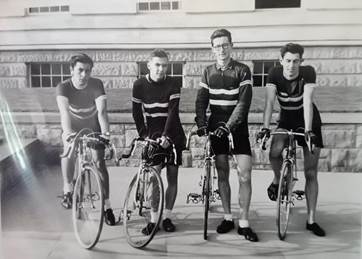
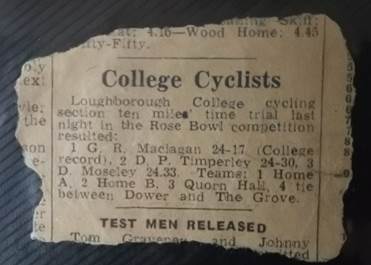
I did enjoy them, far more exciting
than I was used to, and more dangerous by far.
I had to start by entering 3rd Category events, for beginners, and it
was relatively easy to gain a place in the first three finishers. When you had
proved your riding ability and skills, you would be accepted for Category 2 and
1st Category
events. I still have my BLRC Licence
somewhere with my events recorded, but don’t have access to it right now. I rode in one
event as a lone rider during the holidays, round Heaton
Park in Prestwich, just behind Julie's home, where we occasionally took
walks. It was a Saturday ten circuits with narrow loose gravel surface, and I
hated it.
One event partially remembered is
one evening Criterium round Leicester. I was, unusually, in the lead towards
the end, or in a group of three who had got away from the bunch. As we came
within a mile or so of the finish, either I, or one of the others, took a wrong
turn, realised the mistake, and turned left the wrong
way round a keep left sign, colliding with the other two. We all got ourselves
sorted, remounted and finished , 1,2,3, but I'm not
sure where I came in. The changing rooms were a mile or so away from the
finish, and as I stripped off my shirt, arms over head, one of my team pointed
out that I had a big gash across my left ribs, no blood, but with three ribs
shining white through the clean cut. I had only a small hole in my shirt, but
my thigh was badly grazed and bleeding. I think a brake lever had caused the
gash. I rode off on my own to find the
Hospital emergency dept and had five or so stitches, chest bound up, and thigh
cleaned and plastered. I then rode back
to Quorn arriving well after 1 am, finding all doors securely locked of course.
My room window was on the first floor to the right of the main door, and I
tried stones thrown at the window to no avail. Eventually I climbed up the ivy
and got in through the open window, weary and aching.
All the other College cyclists were
from the 'Engineering' College.
Loughborough then consisted of five separate colleges, with all students
belonging to the same College Union.
Roger, a small but wiry lad organised us and
entered team events, A nice lad too was Minoo Damania, an East Indian, who’s Dad had a hardware store back in Bombay. I
wrote to him several times after college, but lost touch in '67 when we were in
Grand Turk. Pete Timperley was another who lived in Warwick and I visited his
home once. One other small lad too ,but I forget his
name.
Another up and coming type of race
in the mid '50's was Cyclo-cross, a mix of bike riding and cross country running while
carrying your bike on your shoulders. This must have been the start of
'mountain biking' but I was not aware of it at the time. I did not enjoy this
very much, too muddy and energetic, and for me, never any good at running, not
very successful either. I hated getting my bike all dirty, and my slim racing tyres were not suitable either. I built up a 'hack' bike from
old parts and Julie's old Viking bike frame, as she had her new James Harrison
by then. It was all good fun anyway. The
college club was affiliated to the British Universities Cycling Union, and team
secretary Roger got an invitation for the team to go to Russia, expenses paid,
to race in University
events there, but I did not fancy the idea, and it came to
nothing.
Once I had settled into college life
and work, I used to ride home for the weekends, go out with Julie to watch her
race, and ride home again after the weekend. I clocked up some great weekly
mileages, and many of my Sunday rides were in the company of mainly women, the 'Manchester and
District Ladies Club'. I remember once
riding along the
road, and a crowd of kids shouting, "Did you see that bloke with all those
women ?". She joined the
Manchester Victoria Wheelers who had a better ladies
cycling team, and I rode with them too.
College work was great, and I loved
it all, except the Drama. The practical woodwork was really high class and the
tutors gave super encouragement and advice. We all had to design and make a
small coffee table first, I made a round one in oak. Then we had to make a
chair to a given drawings to be used in the college library. This was quite
complex and we were able to carve our name and year on the back rail inside. We
had to upholster the seat traditionally with horsehair and sackcloth before the
final red leather covering. It really was a fine piece of craftsmanship. In my third year I designed and made a dressing
table to go with the double wardrobe I was making during the holidays in my old
Grammar School workshops. The college resident Head Tutor in Design was Mr Edward Barnsley, a quite famous designer of furniture,
who had his own workshop selling individual pieces to the rich and famous of
the time. When he was in College he had his room in Quorn Hall and we had the
privilege of sitting with him at the dinner table each evening. He was about 60
then I guess, very knowledgeable and a treat to talk to. His boast was that the
only machine in his workshop was a circular saw, with all other processes done
by hand. He had the longest eyebrows I
have ever seen, a good 2 inches long I'm sure, and he always wore a tweed jacket,
and of course a tie. We too had to dress for dinner. Visitors were allowed for
meals at weekends, and Julie came on several occasions. It was all very
tasteful and upper class. She stayed at
a local pub, sometimes with the girlfriend of another friend Kieth Scammel, also living in Quorn Hall, and with whom I
shared a room in my third year.
The actual teacher training course
was of 2 years
duration, and I qualified in 1956, but as I was 2 years ahead of all my
colleagues anyway, and my parents agreed, I decided to stay on for a third year
to become a specialist Craft teacher, and in fact I obtained a “Diploma of
Loughborough College“, Hons, entitling
me to put DLC after my name on my CV and official documents.
In my second year, I moved rooms in
Quorn, and shared with Dave Finch ‘Finchers’ and
Trevor Scott, from just down the corridor. Then in the third year, with Kieth Scammel only, as senior pupils could occasionally get
single rooms, or at most share with one other..
Sharing a room was never any worry, and I do not think I ever had a cross
word during the whole 3 years. Trevor Scott only did a one
year teacher course as he was already trained in craft from the
commercial side and technical college. He lived nearby in Nottingham, he was
Trevor's godfather and namesake, and we are good friends to this day. I still
correspond with all the others apart from Barry Morris, who I did come across
once in a summer school in the 70's.
Apart from woodwork skills we also
had to learn metalworking which was completely new to me. I made several small
items, from given drawings, as training on lathe ,
miller and hand tools, and then designed a pair of sash cramps, and a standard
lamp. The metalwork and engineering shop was on the second floor of a building
and one afternoon there was a quite serious earthquake when the whole building
shook very noticeably, and
as one student was using the shaping machine and it traced a interesting clear pattern on the smooth machined surface.
The tutor was a bit of a card, I told him I was going on holiday to Cornwall.
"I hate beaches and sand, it gets up your arse
and inside your foreskin" was his comment, and I was rather surprised to
say the least.
In my third year, apart from wood
and metal, we did jewellery, and I undertook a huge
design in silver which I never finished, but the experience was great, casting,
etching and silver soldering. In my spare time, evenings and one afternoon I
voluntarily took Pottery as an extra and also enjoyed that. Some
time too I did weaving, a huge piece of fabric
to my own design on a big hand operated loom. I used a small section of this
material to upholster my dressing table stool.
All in all, College was a ball from start to finish. Even the theory of
teaching, philosophy, sociology, psychology, was difficult for my simple mind,
and I admit to worrying and
putting in essays at the last possible minute, but it all came
out fine in the end.
We had three weeks “Teaching
Practice” once each year, when we were taken on by schools all around
Leicestershire as assistant teachers. In my first one, I was allocated to a
primary school in Burton on Trent, which involved and early start each day, and
a long drive in a student coach dropping us at different schools. I was almost
sick, and always sat on a front seat by the driver. Then we were allocated to a
teacher and class , and given a timetable of two or
three lessons each day, involving all subjects. I absolutely hated this
experience, young children, teaching things about which I had no knowledge or
interest. My history subject was about Hanibal
crossing to India, which I had never heard of…and my knowledge of Grammar, even
at that elementary level was vague, and geography too, useless. Sometimes, a college tutor would drop in to asses us, and
sometimes we would sit in on another students teaching. I remember too that my
allocated teacher was young, about 25, and one day, as we chatted in the break,
she asked if I would like to accompany her to a film at the local cinema one
evening. We were both well aware that I was engaged, but I felt that I should try to be
sociable towards her as she was my ticket to a teaching pass, so I agreed. I
think she was after a proper ‘date’, but she was disappointed, and I had to
catch a train back to Loughborough. The
second practice was in a secondary school in Leicester, and there I felt very
happy, and confident, taking lessons in wood metal and other subjects. My last
one was even better, in the school in Quorn, just a short bike ride away., from
my residence. Here I was extremely
happy, and was given a full timetable, as by then I was actually a fully qualified
teacher taking an extra years training for my Diploma.
I know that there was nothing in the
3 years that I disliked, even being away from Julie made her more special, and
our time together more interesting. During our weeks apart we both wrote weekly
letters telling of our daily doings. Once she was racing somewhere in
Nottinghamshire, with the MDL team, so I rode there very early in the morning,
and she nearly fell off her bike during the race when I suddenly called out
"Get into it then Julie" from the roadside. For me there was never a time of doubt. I left 19 Repton as a lad, and came back as a
man. I really felt different. I was no longer Mrs
Moseley's son, I was David Moseley, and I was more than ready to get married
and forge my own destiny.
Love and Marriage.
What a great part of life this is,
and how greatly it influences every other part.
Again, in all aspects of love and family I have been positively blessed.
Born into a loving relationship, and
benefiting from as stable a family atmosphere as is possible, I thought that
this was the norm. Everyone loves their father and mother, and all parents love
their children ?
Not so. As I have lived, I have
come across many
instances of parents never seeing their children in adulthood, and of children
not wanting to see or speak to their parents. I would not say that this is a 50
50 split, but a continuously variable from one extreme to the other. For my
good fortune, I place myself at the top of the loving and being loved category.
I could not imagine life without my family, and though they grow away in all
practical ways, there is still for me a bond and a love that transcends all
others.
It has always struck me as strange
that there is only one word for love, and so many quite different meanings to
it. I can love ice cream, or bananas or travelling. I can love my wife, and I can love my
children. All those entail quite different feelings inside, and are quite
different things, but still all use the same word. I wonder if this is peculiar
to the English language, or do other tongues have different words
?
Sex too, a part of love, or quite a
separate thing? I had a time in my life
when I really questioned whether love and sex could be separate, but now I know
that they can be separate, but are both much better when taken together.
Sex begins as a naughty word, or at
least it did to me way back in the 1940's. In the air raid shelter, or under
the lamp outside Mrs Gallagher’s. It was not
swearing, like bloody or hell or bugger. It was naughtier than that, more
secretive, and f...k was the dirtiest un-utterable word EVER. I had no idea what it all meant,
and I am quite uncertain how it all came together. I always knew about baby
pigs, and our cat had kittens, and I knew there had to be a daddy, but the
connection was a long time coming together for me.
Children 'play' with one another.
Exploring. Those of us without sisters were perhaps more curious, though I
certainly don’t remember being curious. Audrey Oaks from next door came
on holiday when we were young, to Cleveleys and we slept together, so
perhaps that was instead of a sister in my parents eyes. Later, in Debdale
Park, as children, " show me yours and I'll show you mine", with all our
young group. It was just playing, with no sense or meaning, just kid's play.
From that stage to being in love is very blurred.
One thing I do know is that about
aged 10, the first girl that I noticed, as a girl, came to visit her aunt
and uncle who lived at number
9 Repton Avenue. They
had no children of their own, and I don't know how long she stayed, or how
often, but what is clear in my mind, is that I stopped biting my nails in order
to impress her, so I must have 'fancied' her as a 'girlfriend' Mum had been trying to get me to
stop nail biting for some time ! I think nail biting
was fairly common, and Audrey next door bit her nails for into adulthood,
almost as long as I knew her.
I initially went to cycling club
dances, social events and lectures with music and dancing after the speaker,
with Mum and Dad, and I tried dancing with Mum, awkward stumbling steps, but it looked good
fun, and I decided that I had better get some practise,
though I don’t
recollect dancing with anyone else at that stage. It must have been when I
started riding with the other faster and less family groups that my social
scene broadened, though only in the cycling group. I think I might have been 15
when I joined a night class for ballroom dancing. 'Rene's' at the Denton traffic lights, was up
a narrow flight of stairs above some shops by the side of the market square.
(The stairs were still there when I passed through on my '06' end to end. aged 70 !). Once a week, and we all learned and danced with
different partners, but I generally teamed up with a Vera, as she was a single,
about 23 years old I guess..
We did dance steps from waltz to samba and tango, often to Victor Sylvester
strict tempo, and I loved them all.
I went with 12 of the club on a
holiday to Scotland, organised by Barry Haylor, who later married Audrey next door. I was by far
the youngest. We caught a night train up to Inverness and arrived very early,
around 5.am. Not much was open, so Barry
suggested we try the local 'Baths', which were actually a collection of separate
baths, not swimming baths as they later became. They opened very early for
people to use before going to work in the morning. The huge baths in individual
rooms, had massive taps which poured endless supplies of cold and boiling hot
water. The walls did not reach to ceiling height and we could talk to each
other as we soaked ourselves up to our necks, laughing and joking. I suppose we
then found some breakfast, but I have fond memories of setting off on our bikes
across a long bridge and up the east coast, an adventure tour with friends.
There were Ruth and Neville, a
married couple, Dennis Lloyd, Malcolm and Thelma, Malcolm Orret,
Arnold Wate, Leslie Wakefield who was Barry's lodging
house friend , and Barry the leader who
was currently dating a new girl in the club, Dorothy Carlisle.
One day towards the end of the two
week tour, we stayed at Fort William Youth Hostel, and spent the day hiking up
to the top of Ben
Nevis, the highest mountain in Scotland. It was a hard climb, and some of the
group did not get all the way up, but most of us made it to the top and were
rewarded by a small pile of snow, which we were able to throw about at each
other, even though this was August.
Later, Barry composed a poem in
which he sang, 'I On top of Ben Nevis all covered in snow, I lost my first true
love, through
courting too slow', so I suppose that was his last date. Though I did not know
it at this stage, why it is memorable to me is that one evening, I happened to
be with Dorothy outside the hostel, and gathered through comments and actions that she might be
interested in a date with me. When we got home, I took her out a couple of
times, to the cinema, and we kissed and cuddled in the back row, as was the
norm in those days. I was beginning to realise what
this 'girl' business was about, though I didn’t really have a clue. She could say 'I love you' in ten languages, and I made the mistake
of walking her only
part way home before parting with a goodnight kiss, but I guess I was too slow for Dorothy as we
just remained cycling friends. In fact, within a couple of weeks she was going
out with my best friend Roy, and that lasted quite some time, as he was much
more experienced than I, having gone to a mixed school possibly.
Very soon after, I was riding home
with the group, in the rain at the end of a Sunday ride, and I happened to
ride next to Julie Henriques, who was a cycling friend too, but only that. She
had been a rider with the Prestwich section, but had started riding with us,
the Saxon Road Club, because we had a nucleus of girls interested in
racing. That evening, we were just
entering the Hazel Grove area, after the long 'sprint for the bridge' at High lane, and we were discussing current films showing. She
said, "I'd like to see Dean Martin and Jerry Lewis in
? and I said, "Why don’t you get Arnold to take you ?", as she was currently dating him aged about 27.
She must have miss-heard me, rain , capes, traffic
etc., and she said, "If you'd like to". It was a very happy moment for me, as I would
never have dreamed of asking her out, way above my aspirations and experience.
We then had our first date, really at her suggestion, and met on the steps of
the Odeon in Ardwick, a red letter day in my whole
life. It was no instant red hot romance, but we
obviously got on well, and the dates continued, just the two of us, or out with
the cycling crowd, dancing or ice skating which was a favourite
night out. Julie had her own skates, and a short skating skirt that she had
made, and was quite accomplished, even dancing when the rink was closed to free
skaters. She danced best with another of her old dates, Alan Barratt, from the
Prestwich section, who could also play Boogie Woogie
which I loved, on the piano at the cycling clubroom, and envied him greatly.
So the social life blossomed, in a
very friendly crowd, all dating one another, and everyone knowing the state of
the game, weekends and bank holidays away in Youth Hostels, Thursday nights
clubroom, and probably twice of three nights a week training rides round 'the
triangle', 30 miles, Cheadle, Chelford, Monks Heath
and back. If Julie came training I rode home with her
before going back to Denton which clocked up another ten miles or so. We did
not have a phone at home but Julie was contactable by phone at her aunts and at
work, so arrangements were easy. I hated her saying she had to have a night to
wash her hair !
From almost the start of our friendship,
I knew that
Julie was the one for me, even at the tender age of 16, with hardly anyone else
to compare, I was never in doubt. She being more than two years older, was much
more uncertain. It was really a question of 'could I keep her in spite of the
competition', and I had no inclination to try someone new. One incident stands
out in my memory.
We had been dating some considerable
time, when we were at the Goostrey cafe with others
in the cycling club one Sunday afternoon. She came to me and said something
like, 'Ray has got two
tickets for the Opera tonight, so I'm going home now to get ready.' I was
stunned, probably saying,
"Oh is that it then, OK". He was in his late 20's and
she had dated this same chap previously, from the Prestwich section, who I
thought was a bit of an strange guy anyway as he road
and raced a tricycle, but then she had also been on dates with almost all the
club, nothing serious, just dating. I
had thought I was at the head of the bunch.
Later that Sunday as I rode home
with the others, a school friend of mine, Geoffery
Goodbody, (Oddbod) said that he was going to the
local Ashton Dance Hall that night, so perhaps I should join him. I had never been alone on a 'pickup', to a
dance hall and so it was a new experience.
Completely out of spite towards Julie I agreed, not because I really
wanted to. He and I met at the hall and I danced with several girls through the
evening, but when it came towards the end, I offered to walk one girl home, and
she agreed. I remember a bus and a bit of a walk to her front gate somewhere in
Denton, a short goodnight kiss, and 'perhaps see you next week', and then a
very long walk home, all the time thinking, 'I'll show her two can play at that
game'. It was only a couple of weeks before Julie and I were together again.
Julia Violet Quixano
Henriques, the name alone was enough to blow my mind, and with a 19 inch waist, and slim figure to match, a real cracker,
with unusual facial features, high cheek bones and small rosebud lips, and long
dark wavy hair from her Portugese descent several
generations back.
She made all her own clothes, from
cycling shorts and tops, too evening gowns, coats and fancy dress. She sewed
for her best friend Pat Pickford, also a Prestwich cyclist, and once they went to
the University Ball together with two other girl friends
Sylvia and Little Pat. They all dressed as the four aces, real tops and skirts
in red back and white with embroidered hearts cardboard cards front and back
which they discarded soon into the evening. She told me she was quite shocked
by the behaviour late on as partygoers got drunk, and
I was jealous of course.
I was jealous and on occasions she
chided me for that. She was certainly not as certain as I was that this
relationship was IT, and I knew I was on dodgy ground sometimes. She once
told me, "Don’t
put me up on a pedestal", but for me, that is just where she always was.
I never ever asked myself 'Am I in love
?', I just knew I was, even when we had disagreements occasionally. When I got
to 18, with an enforced
separation looming in the future, I wanted to be engaged, to try
to keep her while I was away. She agreed to be engaged, though even then she
was not as certain as I was, mainly because of my age
I guess.
Sex was never a big thing, and I don’t mean that it was not good. because it was just great, but I could
not separate it from love, and for almost all of my adult life I could not
imagine one without the other. I had not seen the explicit films that are everywhere today, or as far as I remember had any sex
education. I just did what seemed natural with Julie as we got to know one
another. I think we learned together what we liked. Much later in life, there were opportunities
for sex outside our marriage, but I never pursued them, probably as my
conscience, or good fairy, or something inside me just prevented the practical
urge. I don't think that I ever went through the uncertainties of most
teenagers, of finding myself, of dating girls, and of not being sure. but now,
as a late teenager I was certain of my path, and it was to marry Julie. As THE DIARIES show, I was an early starter
on real love, marriage and children, and later in life I was to sincerely thank
God for the way my life had progressed.
Julie's Family.
She was living with her aunt and
uncle, who were her legal guardians of course, though she was almost 21when I
became 18. We chose the ring together, Saqui and
Lawrence in Piccadilly, a saphire with a diamond each
side, and it was the most expensive thing I had ever bought (£25) at that stage
of life, even more than my bike ! The question of
asking her Uncle Les for permission was discussed, and Julie's advice was,
"You'd better tell him we're getting engaged because he's bound to object otherwise“.
In fact I did tell him rather than ask him, and his
comment really upset me at the time. "Why, you're not even as old as our
Brian". They had two sons, the older one, Roy, already married, and we
occasionally babysat for their baby daughter, (who eventually was our smallest
bridesmaid). He was fine, had a Chemistry degree and held a good job in a paper
mill. Their younger son Brian, two years my senior, who was currently in the
army, truck driving, was quite the opposite. He was often drunk when I saw him,
he stole money from his mum's purse, was rude to them and everyone around him. Quite a lad, and
I had no respect for him at all, and so to be compared with him in any way, was
almost an insult in my mind. Later, when he settled down and got married, he
was a cheerful chap, still a long distance truck
driver, but much improved from his teenage years. Julie and he did not stay in
touch, though we remained good friends with the elder son, Roy and wife
Margaret throughout their lives.
I should mention Robert too, Julie's brother, two
years her junior, just about a year older than me. he too was living with Aunt
Jess and Uncle Les. It was only later in life that I came to realise just what a task they took on when Julie's mother
died when she was only 18 and Robert 16. Taking on two teenage children, who
had never really had a Dad, as well as their own two
boys. Aunt Jess was Julie's mother’s sister, and they had always lived close together. Julie's dad died
when she was only 4, and her Mum contracted cancer when she was about 12 or 13,
so Julie took on much of the household chores and responsibility for her
brother. It must have been an awful time for them all, her Mum in and out of
hospital during all Julie's teenage years, and no Dad
either. She did not talk too much about that time, she passed to go to Bury
Grammar school, but her heart was not into learning, more in everyday
practicalities, shopping and even cooking.
I know that this time made Julie the very independent and practical
person that she was. Robert, also in the
Air force when I met Julie was a jolly lad, very tall, always having a round
baby laughing face, getting in with the cookhouse for extra food, and generally
trying to get through his National Service as lightly as possible. I liked him,
and later he met up with Margaret, who he married and they had three children,
Jack, David and Elisabeth.
So here I was engaged at 18, to the
best girl in the world, a real looker, a great catch in everyone's books, and
about to step out from a settled steady life into the unknown, training to be a
teacher, not wasting two years in the forces after all.
( COLLEGE
YEARS 1954-57 still to be written, using weekly letters to Julie,
and kept by her, wrapped in a ribbon, found when she died. )
JOB SEARCH
College finished in July, we had
three full ten week
terms then. I started applying for teaching posts way before
most of my mates, because I knew that
my life was due to change once again very drastically.
While I busied myself scanning the
Times Educational Supplement each week, and applying for posts, Julie spent her
time planning our wedding.
I had long since decided that i wanted to live somewhere in the South of England. The
change of climate from Manchester in the North, to Loughborough in the Midlands
had been so marked, that the south must be even better. Julie
I know was more uncertain of the move, "We will lose all our friends"
was her biggest worry, not to mention our cycling clubs, racing and the social
scene that went with it, but she was agreeable to try it, and the prospect of
setting up her own home excited her as much as it did me.
I applied for 12 posts, probably
over a few weeks in March I guess, and the first reply I had was from a school
in Hampshire. On May 16 I travelled to
Winchester for an interview. An old Grammar school was opening as a Secondary
Modern School in Odiham, a new workshop and a new building added to the old
16th century building.
It was coincidence of course, or
maybe that fairy, or Gods will, that the interview was actually ON my 21st
birthday. I stayed in a Winchester Hotel, the first I had ever stayed in, and
had the biggest breakfast I have ever eaten. Eggs bacon etc,
but with the very memorable Broad beans ! I have never
before or since had green broad beans for breakfast. It WAS a special day too
as the interview must have gone well and I was offered the post. I don’t know how many were called for the
woodwork post, but I met two other staff who were already teaching in Odiham,
Stan and Cyril. They were being interviewed for their own jobs which seemed
strange at the time, but they asked what I knew of Odiham, which was NOTHING of
course, and told me about the area generally, air force base etc.
There were about six interviewers,
school govenors, the new headmaster, and county
education officers. Clearly in my mind was a question from the C E O, who
chaired the panel. He looked down at my application form and asked, "You
are rather young for a teacher, do you think you have enough knowledge to set
up a new workshop, order the tools and such, let me see you are .... Oh my goodness, I believe congratulations are in order, 21
today". I was of course very confident of my abilities, at 21, who isn't ?
Thirteen years later, when Calthorpe
Park School was officially opened in 1970, that same CEO was being introduced
to the 15 staff, and he remembered giving me my first post on my 21st birthday.
So, we knew the location of our
first home. At the interview, the Odiham Lloyds bank manager, a school
governor, had offered to try to aquire a council
house for me, as they knew my plan was to be married. Julie and I had of course
discussed this, and she had the proceeds from the sale of her mothers house when she moved in
with her aunt and uncle. She also had some investments left to her in her
grandfathers will, (F Q Henriques ), and she thought
there would be enough for our first home.
I do not remember exactly when, but
we cycled down from
Manchester to Odiham, probably in the Easter Holidays, to start
looking for a house. We stayed at the George Hotel in Odiham. I think we took 3
days to ride down,
staying with College friend Trevor Scott and Edna in Nottingham ,
and getting to Thame on the second night, a pub
overlooking the market place.
Our first step was to see the bank
manager, the school governor, who welcomed us and made us feel at ease
immediately. Then estate agents. We looked at a new bungalow in Hazeley first and then at another Crookham village, and
finally one of five just being built in West Street Odiham. I suspect that it
was Julie who directed the search. and I probably left the choice to her,
but after the builder had showed us round the Odiham one, we rode to the Hartley Wintney
Estate agents who were selling the 5 new bungalows, and sat in his office in
our shorts and shirts. He was only a young chap, and he nearly fell off his
chair when we said that we would not be requiring a mortgage. He offered to
show us round the bungalow again, so we rode back on our bikes and he came on
in his little car, being quite amazed that we got there before he did.
The grounds were a builders mess of course, and the garden quite overgrown with
high golden rod, and the third bungalow was almost finished. Ours was the first
in the row, and only a quarter of a mile from the school. We only stayed a
couple of days I think, and I don't remember the ride back, but possibly Julie
rode the bath Road 100 in Pangbourne on that weekend, before we went back home.
When I told Mum that we had
bought a bungalow for £2,575, her comment was that their house
was only worth £1,900, so it must be a huge bungalow. She couldn't wait to see
it.
THE WEDDING
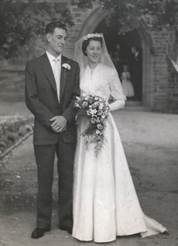
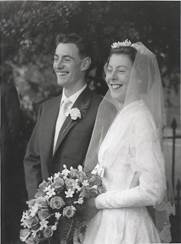
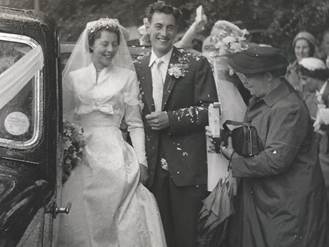
The wedding was all booked for 20
July, only 5 days after I finished college. True to her nature, she had every
little thing organised for wedding and reception,
having sent out all the invitations, though I actually wrote them out in italic
script. She had her wedding dress made at the best store in Manchester where
she had once worked, though she made all her own 'going away outfit'.
The church was in Prestwich, All
Saints, just 200 yards from her ant and uncles house. the vicar had insisted that I had to be baptised before he could marry us, so I had to go for a
ceremony a few weeks before, with only Julie and I in attendance, no crying
babies to compete with !
Mum of course was very excited, a
new dress, but Dad wore the same suit that he had been married in, so you know
who I take after. I had been measured
for a new suit, paid for by parents of course, "You know this is the last
thing we’ll be
buying for you."
To be honest, I don’t remember the day very well. I know
that parents, Steve and I all had a taxi to the church, and that we got there
very early. I walked along to the chemist shop with Barry Haylor,
my best man, and bought some Durex contraceptives, just before entering the
church. The service was printed, as was the reception menue The photo album, by the official photographer booked by Julie, shows
that we left church under an arch of bicycle wheels held by the cycling club,
and the reception was at an hotel just on the corner of Heaton Park.
After the reception we boarded a
train to London, where we stayed the first night, before going on to
Torquay. Several club members were at
the station and they filled our compartment with confetti. That night in London
the traffic noise seemed to go on all night, but we did not care. I know she
only showed me her new bikini if I promised not to touch her, and then she
changed into the most see through short nighty I have
seen to this day, like a transluscent rainbow in pale
colours.
The details are not clear, but I
think that it was only a couple of weeks before my teaching term started that
we moved into the Odiham bungalow. Possibly the buying and completion took that
long. We had a firm of solicitors from the Bury in Odiham, and Chris Hill, then
a junior handled our case, and he became a firm lifelong friend.
The move down was exciting too. Dad had offered to take all our 'stuff' down
on his lorry, though it was quite illegal at the time as he was only licensed
to carry produce. I know he was rather on edge in case we should be stopped for
any reason by the police.
First we collected al Julie's belongings
from her Aunts, out through the back gate and the yard. She had a full bedroom
suit in solid mahogany, very large by today’s standards, two bikes and other personal stuff
too. Then round for my stuff.
This is memorable for one thing. Dad
really put Mum in her place. Generally
she was the organiser but as Dad started loading my
belongings, she offered her advice, "wouldn't it be better..... ". I have never known Dad be so positive and firm.. "I'm doing this job and I don’t want any help from you." She
opened and closed her mouth in disbelief, and I did the same, it was so out of
character for him.
I had furniture too, A kitchen table
with opening leaves and a drawer, that I had made in our shed, the mahogany
wardrobe made in the school workshop, and other bits I had made during my
school years. I had probably three bikes, spare racing wheels, lots of tyres, plus personal stuff too.
Then next day we all loaded in, Dad and Mum in the front, and Julie, Steve and I on the
back of the lorry, under the tarpaulin !
Our first stop was at Loughborough College where I collected my dressing
table and my toolbox and a few other pieces made during the course. Then back
under the tarp. Steve had brought his
'poppit' cowboys and indians to play with on the way,
and it was a smooth but quite dusty ride. A strange journey into a new world.
ODIHAM ---- NEW HOME.
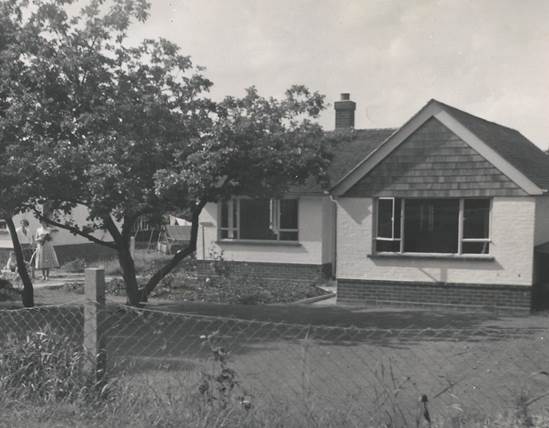
Mum was delighted with the bungalow,
and we delighted in showing them round. Still smelling new, damp plaster and fresh paint and emulsion, two bedrooms, bathroom kitchen and
living-dining room, A feature we al liked was the
living room which had windows on two sides, plus a large french
window into the garden, very light and airy. Steve dashed into the back garden
and immediately was hidden by the shoulder high Golden Rod. The site had been
the orchard of a cottage across West St, belonging to Mrs
Batten. She and husband 'Jean' from RAF Odiham became long term friends too.
Opposite was the council estate, home to most of my students. Odiham then consisted of either council
houses, or people with big houses, horses and pastures, and our bungalows were
really the only 'in between' , normal housing, apart
from a few down towards the canal bridge on the Hartley Wintney road. It was
definitely a village, small enough for everybody to know everybody else.
Being the end bungalow, we had the
village allotments all along one side They were full of crops, lovingly tended,
not a weed in sight, and the path ran along our high hedge. Where the drainage
system had been installed there was a break in this hedge about 8 ft long, with
a low wire fence and posts. Of course, all who passed had a good look into our
plot. I had NEVER put a spade into the soil, weeded, or even cut the grass in
my whole life. Mum did the garden, and Dad cut the grass.
One day, soon after we moved in, I
talked to an old chap who frequented the path. He was Frank White, who lived
further up West Street with his sister, part of the large Odiham and district
family. I admitted that though I had bought a fork and spade, I had never done
any type of gardening before, or had any experience. He advised that the whole
plot was full of bindweed that needed 'deep double digging' to get rid of it.
He also offered to do the job for me ! I expressed my
thanks for the offer, but suspecting that maybe this was for pay, and as I was
not yet ready to begin any garden project, we left it without a yes or no. To
our great surprise, the very next morning, as we emerged for breakfast, there
he was at the bottom of the back garden, and by the size of the cleared area,
he had been there since daylight. It was a strange situation, so we took him a
cup of tea, which he declined, and hardly uttered more than a greeting, never
pausing in his work. Every day from then on he was
there working until about 8.00am, when he would leave. The plot was a quarter
acre, and he dug every square inch that was not drive or building. He built the
huge pile of weeds into a closed-in fire which smouldered
with a wisp of smoke from the top, and I still love that smell. Occasionally it
would burn through and break out, and eventually there was a pile of ash a full
8 ft in diameter and at least 3 ft high. All the back garden he planted with
potatoes, two varieties, and told me that as I dug them out, the whole plot
would get yet another thorough digging and weeding. Our plot had a bank, outside the front fence,
between the road and the fence, and on it were two huge elm trees which made
the front of the plot and the bedroom very dark. "You should av e
out", suggested Frank, I'll soon av e down. true to his word he was up the
tree lopping branches, and soon the whole tree was in our front patch, cut into
moveable and choppable chunks, and all with a handsaw and an axe. Frank was a
man I hold very dear in my memory.
By now a year had gone by, and when
Gina was born in our bedroom,, I burned the afterbirth
on the front patch with the last of the tree foliage. 1957 and 58 were certainly times of change, a
new job, workshop to set up, new friends to meet, and the plot to make into a
garden, while Julie concentrated on sewing curtains, getting our home to her
satisfaction, and honing her cooking skills. I seem to remember that she
complained that she could not make thick gravy, and that her sponge cakes often
sank in the middle, but I never had a complaint..
After moving in, we had my kitchen
table in the living room, an old chair salvaged from Uncle Oswald’s old home. of
course the bikes were all in the living room. I had my toolbox there to
sit on, and we had a small radio that we had bought for me to use in college.. The bedrooms were OK. We had Julie's full suite,
and Mum had given me my old bed for the spare room.
We had already ordered a Morris
Design dining table, chairs and a sideboard from a Manchester store who could
deliver it to us, but we went into Reading by bus to order our three piece suite, and buy curtain materials etc. It was a
day trip there and back, usually a Saturday.
On our first Christmas, Julie
presented me with a series of small packets. I have no idea what I bought her,
but she really surprised me. A Triang TT 060 tank
engine and three trucks ! Some time during my
three college years, Triang had brought our this new collection of model railways, smaller that the 00 range which was the major scale and which I had
passed over to brother Steve about 10 years previously. On our shopping trips
in Manchester and in Loughborough during her visits, I had admired this new
range, with great enthusiasm, but never had I imagined owning one now that I
was a grown married man, with a house and garden to look after. What a girl ! Of course it was no good without the track, and a good model
railway shop in Reading, by the station soon put that to rights.
The bungalow had a coal burning
'maxi' grate, and on the first day of school I asked one of my pupils where I
could buy coal. Whites of North Warnborough I was
told. I was really amazed when I got home
that evening and Julie informed me that the coal man had called,,
having heard from his daughter that we needed some fuel,, and that
she had bought three bags full. "I didn’t know where he should put it, so
it's in a pile by the back door,"
I had never done any building, but
obviously we needed a coal shed. I drew a scale plan of our whole plot, and we
decided what needed doing. A patio with a low wall, and a coal shed. Winter was
coming, and soon we had our kitchen and french window
back steps surrounded by paving slabs, and a small hollow wall planted with a
selection of plants recommended by Solicitor Chris Hill. His father was the
head gardener to Neville Chamberlains daughter who lived in her huge house
fronting onto the Bury, and her garden was both sides of my path to school
through the churchyard. I tasted my first asparagus fresh
picked from her garden, and watched as buckets of blood from the Odiham abbatoir were fed to the grapevines in the greenhouse. That
was a BIG garden.
Down the side of the bungalow was a
narrow tapering strip of land between hedge and house wall. Here I built a
wooden lean-to long shed roof to store firewood, and the bikes. The hedge ran the whole length of the plot,
and across the back, and it took a whole week to cut, only having shears, no
readily available electric cutters then.
One weekend we went up on our bikes
to visit one of Julie's old school friends Shiela who had married a Birmingham cyclist,
and they lived there in their new home..
We had been to their wedding, and had a Summer two week
holiday with them previously in her fathers car to
Torquay. They had married a year or two before us, The Wellavises.
We had a good weekend staying with them, but it was overshadowed by Julie
discovering that she was pregnant ! " But I don't
want a baby, I don't even like them", was her complaint, while I grinned
from ear to ear. It was definitely not planned, but it was not a calamity either.
We were in a nice home, we had enough money, Julie did not have to work, what
better time to start the family ?
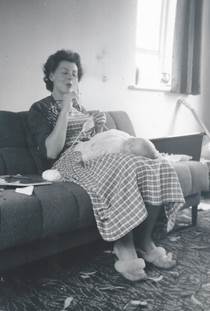
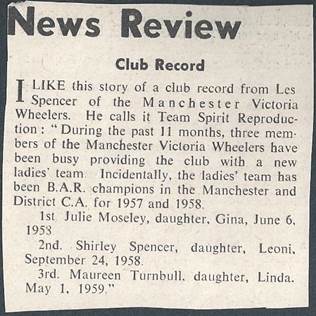
The day after Gina was born at home,
I went into Odiham to
the chemist, and across the road was the bus stop. Quite a crowd were waiting,
and it was outside one of the lady school govenors houses. As I crossed the road, she came out with
her daughter, and on seeing me she shouted to her daughter, and all the
assembled crowd, "Oh, this is Mr Moseley, a new
teacher from the school, and he got his first teaching post, got married,
bought a house and had a baby, all in his 21st year". I could have crawled
into the nearest drain.
The bikes had been out with the
Basingstoke CTC on a few rides, and a new baby was not going to stop us riding.
We ordered a new Watsonian sidecar, the best available. equal to the tall and
elegant Silver Cross high pram she rode in. The only bike that had thick enough
chainstays was our Houldsworth track bike, and so it
was fitted, and off we went, into Basingstoke and on the Sunday rides. There
was immediately a big problem as I have never been able to ride up hills
sitting down. Standing on the pedals is called 'honking', with the bike
swinging from side to side while the rider stays upright. This played havok with the trailer tyre which
wore out in less than two weeks. Coupled with this, the frame had very upright
angles, as suited a track frame, but it was far from a steady ride, and one day
going over the canal bridge, the sidecar wheel caught on the kerb, and mounted it, bringing bike and trailer to a
crashing stop, almost turned over. That was really the end of leisure cycling
for us both for the next thirty years. We kept our bikes, and I rode mine daily
in to school, and short shopping trips, but that was all. I don’t remember what happened to our new
sidecar, but I do remember giving my double chainring and gears to a young lad,
Nigel Reynolds, son of an RAF chap we knew socially, never guessing that he would become
one of my future sons in law!
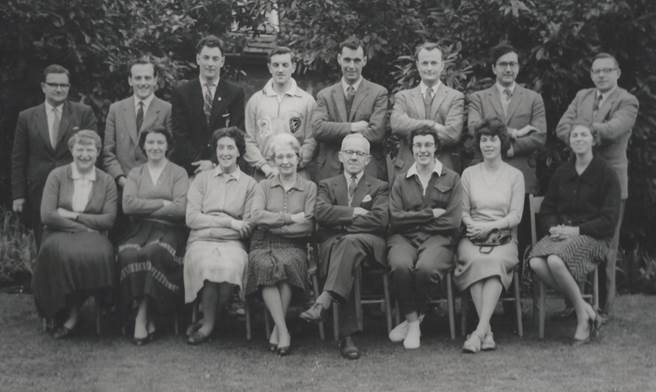
It was an exciting time, and things
moved quickly. School settled down with a considerate headmaster Mr Thomas, and twelve staff, eight of whom were fresh out
of college. Myself, Pat Rodwell art, Pat Collinson PE, Beryl
? Domestic Science, Shiela Freezer science,
Mary Sadler English ,
and Margaret Jennings who taught typing and had been a secretary before
her teaching course. Experienced staff were Stan Morrant
maths and science, Cyril Cooper, history, Mrs .?
Watson, who was deputy head and took remedial classes, a New Zealander Brian
Smart for geography, and a semi professional
footballer for PE who was a big bully. Being a very young staff we all got on
well and developed a group spirit. The youngest were all single, living singly
or in groups, in rented accommodation, and we seemed to become a meeting centre, having a house of our own.
Chris and Edna Hill became our new
close friends outside the school circle, they were avid card and games players,
and Saturday evenings was often a games night with them. Also there was cinema a few hundred yards up West St at the top
of Dunleys
Hill, and that was another occasional night out.
My teaching seemed to go well, I
started a Model Railway Club, after school, with pupils bringing their own
models to run, which was quite a success. As a result of this I found another
very good friend. The school dentist had a room upstairs in the old building,
with a dental chair and
equipment for an annual check on each pupil, and remedial work if necessary.
One day he saw me carrying a copy of Model Railway magazine, and it transpired
that he was an American Model railway enthusiast with quite an impressive
collection of models. He agreed to bring some of these in to show the school
club members, and so the friendship began. He initially lived in a small flat in Aldershot above his practice, but when he moved into a
bigger house, he always seemed to have plenty of cash to spend on his railway
in his loft and often one evening a week
I would spend helping lay track on his layout. I was pleased to be asked to be a Godfather to
one of his sons. John Gray and wife Shiela,
remained a close friends until his early death around
1982, and I still correspond and meet with Shiela, in
Winchester.
Of course we both missed friends back in Manchester,
and we did travel up by train a couple of times, particularly for Christmas
when we stayed with my parents. Travelling this way with baby Gina was not
easy.
Soon after Gina’s birth, we had some friends visit us from Australia who had hired a vehicle for the duration of their stay in UK. It was Bedford van with windows in the back and hard wood slat seating for 12 people. It was called a 'farmers model', and we were very impressed with it as a multipurpose family transport. I think that it was probably around spring of '59 or '60 that we bought one of these. Neither of us could drive, but our next door neighbour Mona agreed to drive round with me , and she came with us to collect it from Vauxhall dealer Bakers Garage in Aldershot. I think I was fairly fast learner, but I still took two attempts to pass the Driving test. The first was in Winchester, and everything went very well until I came to the three point turn. I completed this OK, and after, parked by the kerb as requested, but when I came to pull away, I could not engage first gear. Try as I may, it would not engage. The test had to be abandoned and we returned to the test centre using only third (top) gear. The tester congratulated me on this feat, and promised a swift re-test when the vehicle was repaired. The van was only a few weeks old, and the mechanic sent to fix it in our drive had to first push it out of the garage backwards. The linkage had come loose at the gearbox.
Willie and Mona lived next door in
'Farthings' and they had two girls who were in boarding school. They were very
pleasant, and good neighbours, but they had fallen on
bad times when his company went under for some reason, hence the bungalow name,
that was all they had. He was out at work long hours, and she on her own. Each
week she bought 7 boxes of Cadburys Milk Tray, and she ate one each day, and
nothing else. He ate out during the day. She never cooked. It was a strange way to live.
On the subject of food. Just on West
St was a small grocers shop called Bidiscombs, and Mr Bidiscombe provided Julie with an “order book”, in which
she would write down all the items she bought on a regular basis, and he
delivered these items each week on a certain day. We could of course pop in to
buy any item at any time. Later as our children were born, his daughter Lyn
used to babysit for us, and of course I taught her at school. Also Susan Gubby babysat, as we began to have quite a social life.. There was also another grocery shop, a delicatessen
on the Odiham High St, owned by Mr Dicker, a rather
‘upmarket’ man with fairly expensive and unusual produce. Julie tended not to
shop there. Some time later I think, a large fruit
and vegetable shop opened on the other side of the street, owned by the Whites,
and a small Coop, with Manager Mr Baughurst,
two barbers shops, and at the bottom, a blacksmith
Jack Read, and a small bus company, with one blue bus. My memory here is
probably rather vague, as life moved on very quickly,
School life, family growing in numbers and from babies into small children, building a large brick cavity wall garage, and then another big bedroom with a brick boatshed by the side, landscaping the front garden, concreting the front drive, all seems now to have passed in a flash, and probably it did. Looking back now, when my pace of life has slowed almost to a stop, it all sounds almost impossible. I really enjoyed every moment. School was exciting, the woodwork, and Technical drawing, plus the after school clubs, model railways, with train trips into London for interested boys, and then ‘Scalextric Racing cars’ with a huge wooden figure of eight track, raised on pulleys into the ceiling for storage. One particular School Governor was always very supportive of my endeavours, Mr Benford, who owned a big farm. He regularly gave donations of money to buy items for the clubs use, supplied paint, and latterly when we built 10 canoes in the workshop, he was very enthusiastic. There were night classes too for adults in the village and I made several very good friends through meeting them in this way. One man, a building expert and father of a pupil, gave invaluable advice on building matters, and several others remained friends long after we moved away to Fleet. In my third year teaching, when the Geography teacher moved back into New Zealand, I was promoted to organise all the night classes, teacher claim forms, and promotion of new courses. It was the money I earned from this, that I used to build my first 14 ft speedboat, in the school workshop. Mr Thomas allowed me to do this, on the provision that I would complete the build in one term. This I did, starting during the Christmas break, and launching it at Burghfield Lake Reading, in the Easter Holiday.
I taught in Odiham, Robert Mays Secondary School for nine years, 1957 to 1966, enjoying all it’s aspects, but one incident gave me a reason to move on. We began with only 11 staff, and staff changed and the school numbers grew. Teachers were paid in scales, 1 to 4 I think then. I began on scale 1 of course as did almost all the staff. After 8 years, I was still on scale 1, and a 2nd scale post was given to a typing and RE teacher, giving me the feeling that I had been bypassed. It was time for me to move on.