BOATS.
Dads Model Boats.
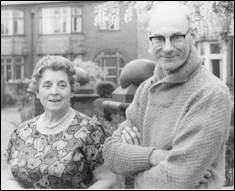
My earliest memory of any kind of boat is of my Dad building model yachts in the living room when I was still very young . He had the kitchen table which was a heavily built one, and on top of that he clamped a long flat plank that had a woodworkers vice fixed underneath and on one edge. I clearly remember piles of curly shavings, and very long thin strips of wood, but I think I must only have been a baby when he built 'Carefree' , a 6 ft Daniels design of complex construction, having ribs that had to be steamed to shape, and thin planks fitted with tiny screws. The deck was ever so thin, a single layer of wood, really fragile. The mast was so tall that it could not be fitted indoors though our ceilings were a full 8 feet high. I only have memories of being taken along to sail this boat.
He belonged to a model yacht club in a park called Platt Fields, in Levenshulme Manchester, and we travelled on a bus to race it on Saturdays. It was here I began to learn about sailing, the wind, and tacking. A race was in two parts, a tack up the pond against the wind, when the boat had to be turned round, tacked, by hand as it reached each side of the pond. This is where I joined in, being on one side, while Dad was on the other side. The second part was a 'downwind' sail when the sails were set with one sail on each side if possible, and an elastic device was fixed to the rudder and sails to keep it steering directly downwind. If the wind did not allow this, being slightly across the pond, then it had to be tacked from side to side again but in longer tacks and with the sails set further out from the centre of the boat.
There was a clubroom where the boats were stored, and one of the sailors, a Mr Duckworth, who was the secretary, and a dentist, was also in the cycling club. I think that most of the members built their own boats, which were of several sizes and 'classes'. Once the brick club boat house was broken in to, and the thieves, or vandals, got in through a skylight dropping onto some of the boats. Dad's boat got some damage to the deck, and I was able to help mend it because my small hand and arm were able to reach inside the hull through the small deck hatch.
The metal fittings for the deck and mast were also home-made, from brass, bits of flat sheet and tube, and soldered together mostly with a small brass blowtorch with cotton wool and methylated spirits inside. He had to blow this by a rubber tube in his mouth, and he amazed me by being able to blow out continuously while inhaling through his nose. Try as I may, I still cannot do this.
He entered racing competitions outside the club and one trip I know was to a large lake in Bury, and he was very proud when he won a second prize with his big yacht. All round this lake were wooden paths so that the yachts could be tacked easily. It was quite difficult to travel on the buses any distance at weekends, carrying this 6 foot long yacht, with an even longer mast, a full day with a picnic lunch. This big boat was called 'Carefree'.
I suspect that as a smaller project, and connected with his interest in the merchant navy, he made small scale waterline models of ships. The hulls were only 7 or 8 inches long, made from about one eighth thick strip-wood, with the superstructure detailed, with smaller pieces, and the whole thing painted matt grey. Tankers trawlers and even royal navy ships I think, and they were kept on the front window ledge.
The next sail boat he built was for me, and I think I must have been about 5 or 6 at the time. This was a much simpler construction called 'sandwich' or bread and butter', as thick planks were cut roughly to shape and then glued together one on top of the other. The final shaping inside and outside was then completed. It was at this stage that I remember floating it in the bath, and putting lead weights inside to get the waterline and trim about right. I was, even at this young age quite concerned that the lead would sink the boat, but I must have got a full explanation that obviously satisfied me at the time. The weights were cast using a metal ladle heated on the living room fire. When the correct weight was found, the lead was recast into the keel shape, to blend into the shape of the keel..
TRIX
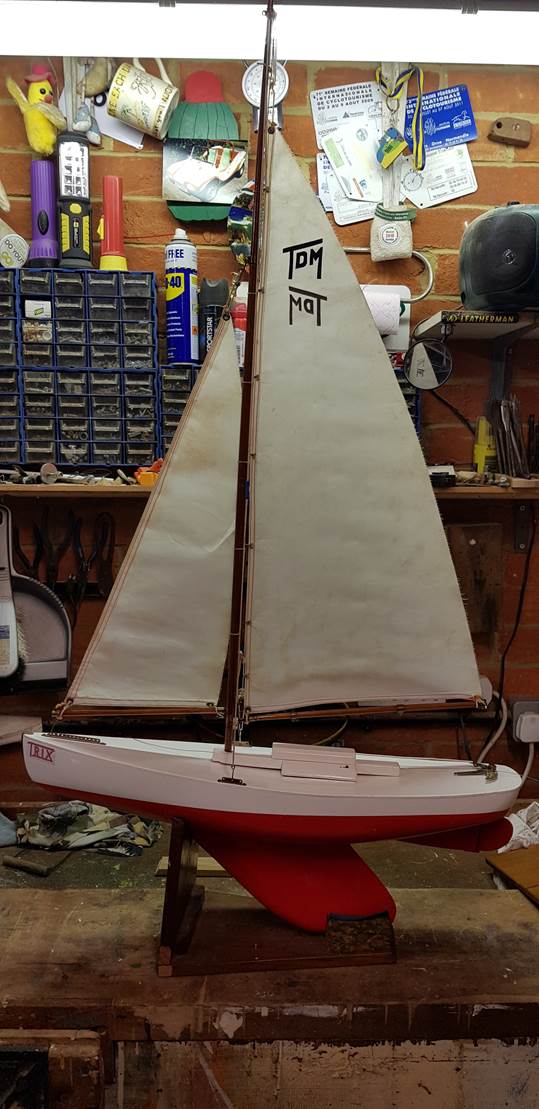
(same boat but much later modified with radio control)
My 2 ft sailboat boat was called TRIX because he told me it would do marvellous tricks on the water. I almost lost my boat during its sailing trials. He had designed the boat himself and at first the mast was in the wrong place and had to be moved, either forward or back, I don't know which. We had walked from the house, and were trying it out in a clay pit at Reddish, but he had not filled in the original small mast hole in the deck. As it was quite a windy day, the boat heeled over and half way across the lake it began to sink until only the mast tip and a small part of the bow were above the water. I was in tears and heartbroken when we had to leave it and walk home, but we went back with a long string with a weight that he intended to throw out to try to pull it in. In fact it had drifted almost to the edge when we got back, and it was easily recovered, but again I linked the incident with 'that lead keel', and have never believed in them since.
The last boat he built was three feet long, sandwich method again. In this class the design limit was that the complete hull had to fit inside a box with inside measurements of 3ft long and 9 inches wide, but the actual hull lines were his own design. I do remember him cutting the sails, out of special cloth like paper, and painting them with some kind of spirit, and the mast and boom were made by gluing together several thin strips and then planning it to a tapering round shape. I suppose now, that most of the work was done in the evenings, when I must have been tucked up in bed. This model yacht was launched called Rita, I think maybe after Rita Heyworth, a film star of the time, and because I had just been given a baby brother Stephen, and if he had been a girl she was to have been Rita.
Whenever we visited the seaside, we looked at boats of any kind, discussing the different parts and rigs of the sailboats. My Dad had wanted to be a radio engineer in the merchant navy, but his dad would not let him, and so he took his book-keeping exams instead and had a job driving a truck and selling potatoes to greengrocers and chip shops. Perhaps it was a good thing he did because his dad died when he was only 18, and his Mum was very ill from then until she died in a mental hospital when I was still young and I only remember seeing her once.
WOODWORK
It was his initial interest in wood construction and tools that gave me a start, and very early on I made a solid wood box with 'finger' joints. On one corner I had cut out the wrong bit which left a gap, and so when I floated the box in my bath it soon filled with water. We had a small shed, and the plank and vice lived in there. I was always sawing up bits of wood, had my own small tenon saw and a wooden plane too. I made houses, out of apple boxes, for my white mice which I bred to sell to a pet shop, and was a weekly reader of 'Hobbies', a practical magazine which had fretwork designs. I well remember one that had drawings of a toy train and wagons, using half cotton reels for wheels and which I made.
In my early and late teens, boats took a bit of a back seat in the family and cycling took over. I was lucky to have a very good woodwork master at my school Mr Eastwood, who helped me further my skills and understanding. Though I passed to go to the Audenshaw Grammar school I struggled to be mediocre at anything academic, and I only came to the fore in art and woodwork. Mr Mark Gibbs, the lower sixth master suggested that, as I loved woodwork so much, I could perhaps train as a woodwork teacher so that I went on to college and am grateful to him to this day.
Robert Mays School. 14 ft SKIBOAT TRIX.
I married and moved down south away from the family home,19 Repton Ave, in Manchester, to teach in a small new secondary school, Robert Mays in Odiham, Hampshire. Then it was that a different kind of boat next fired my imagination. At the age of 22, we tried water skiing for a fun weekend in Pool Dorset, with a crowd of other teachers. I was immediately bitten by the bug, and within a couple of weeks had made myself a pair of water skis. They were laminated from plywood, and the bindings were also and made from a sheet of rubber and some aluminium sheet. There was a waterski club on a lake near Reading and on several occasions I paid for a ski round the lake on a Sunday morning. By then we had a Bedford Van, farmers model it was, with slatted seats along each side with windows, and steps at the back doors. Margaret Jennings came with me for an outing, while Julie nursed Gina I guess. It was difficult to get out of Odiham, and not many folk had cars then. Very soon I wanted my own ski boat, and thought I could build it myself.
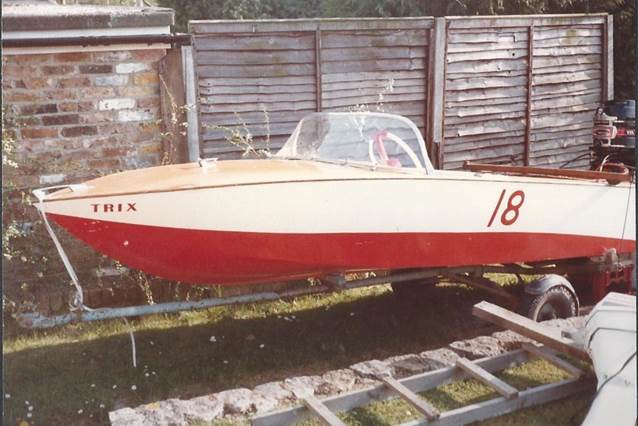
I worked out that if I saved all the money I earned for my evening class work, where I taught woodwork classes and also was the organiser of all the night school classes, I could afford to build one. Two members of the ski club, Paul and George, had a business on the Thames at Reading, Caversham Bridge, where they were building wooden ski boats, and I had initial advice and help from them. They laminated the keel and stringers for me and I think made the Transom. The building took one term, and I had permission from the headmaster to build it in the school workshop. It was finished and launched during the Easter break, and again took the name of TRIX. It was a 13 foot ski boat, built of marine ply over mahogany laminated rails, the design of which was virtually 'copied' from a 'Sabrecraft'. Painted bright red and white with a gorgeous varnished deck, with the name in big italic letters on the side painted on by my art teacher friend, Mike Burton. The engine, a cream coloured 40hp Mercury, pushed it to 30 knots, and easily pulled any skier out of the water. I joined the Burghfield Water Ski Club and happily skied there for the next 9 years, upgrading the outboard to the new black 60hp as we got more advanced on the slalom course.
CANOES.
A student in my night class, a young locum doctor, Phil Cotterell, came to make a canoe. He had a kit for a Granta design, with a wooden frame and canvas cover which he finished and launched on the Basingstoke canal which runs through Odiham. This was my first introduction to canoes. Afterwards, one of the older boys at school asked if he could make a canoe as his final GCE Project. When I looked into the possibility, I came across the Kayel plans, built entirely of thin plywood using a 'stitch and glue' method and fibreglass for the seams. This method was really new so I formed a school Canoe Club, and in just one term we built 10 canoes, for myself, the PE master, and eight fifth year boys. They were built after school , and launched with much ceremony in the new outdoor school swimming pool, and sporting such names as 'Approximation', and 'Satisfaction'. During the building, the PE teacher and I took a week long residential course in Wales in canoe handling and safety , Plas Y Brenen. Each pupil had paid a total of £10 to build their own canoe and take part in two long weekends canoe camping, during the Summer term, one on the River Thames from Oxford to Reading, and the second on the River Arun from the very source down to Bognor. The trailer for Trix was adapted with builders scaffolding to carry all 10 canoes, and towed by our Bedford Dormobile. Later on, the PE Advisor asked me to experiment with some new fibreglass moulds that had been bought for the new Outdoor Pursuits Centre at Calshot, so we built two or three of these.
GRAND TURK ISLAND
At the age of 30 I took a teaching post in the Caribbean, Grand Turk Island for two years (1966 -1968). I stored Trix, in the boatshed by the side of the bungalow, which was rented out to the RAF during our absence, but took the 50hp Mercury outboard with me as personal belongings. There I lived on a fantastic beach and the sea was a constant part of our lives. It was not long before a new boat, a 17 ft seagoing but open topped speedboat was on the water. This boat hul was to my own design. New 'deep Vee hulls' with longitudinal strakes were the new 'in' design which I included in the design. Only two central frames, close together, incorporating a steering station, with heavy laminated keel chines and gunwales. It flew along, with the 60hp Merc brought from England, was as fast as anything on the island, and was called 'TURKEY' (it gobbled up the miles, and was built on Grand Turk). We skied most days after school and at weekends, as well as family outings to other smaller outlying islands. We towed all sorts of fun devices, a round disc of plywood which you could lie, kneel or stand on, and home made water skis of course. All our children learned to ski well, though strangely enough, Julie only ever tried it once. She did get up, but insisted that it was not something she enjoyed.
TURK FLATTIES.
Then a fellow ex-patriot, the Grand Turk Island police force chief, Andy, asked if I could build him as cheaply as possible, a small sailboat based on the 'Sunfish' design, with one lateen sail. I did this, but it sailed like a log, at only 9 ft long, and would not go to weather at all, in spite of a lifting dagger board. It only cost £10 including a cotton sail run up by the primary school headmaster, also a tailor, and was built almost entirely from one 16 ×4 sheet of cheap quarter inch exterior ply. The rudder fittings were fashioned from tin cans, the mast laminated cheap fir. Its poor performance deemed it a failure and it lay on the beach for several weeks until a new ex-patriot came to work for Cable and Wireless, Brian, who had some 'Sailfish' experience in his previous posting. .He tried it, and announced that it needed a higher mast and double the sail area.
A few days later, we had a great boat, which I called called a 'Turk Flattie', but true to history I had to move the mast back three inches before it really took off. This little sailboat became the envy of all my school pupils, who would crowd around my garden/sea wall wanting to take it for a sail. Clearly there was an interest to be fostered.
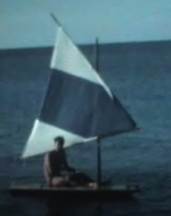
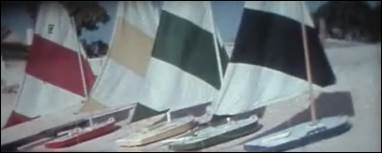
I persuaded my headmaster to 'invest' £40 to have the schoolboys build four 'Turk Flatties', one for each 'house' in the secondary school. They were built after school, with no problem getting them to stay behind, in fact it was difficult to get them to go home. The launching was watched by almost all the school, quite an event. We now had five of them, all painted very bright colours with striped cotton sails that needed to be wet before they held the wind to any degree.
I had a very good friend, the Methodist minister, Derek Softley, who skied with me, who then asked if his church youth club could build one, which they began to do. Immediately word got around that this was happening the Anglican Minister was at my door asking if his youth section could build one too. This brought our fleet to 7, and then things began to really boil, the school head boy built one for himself,..... and soon we had a fleet of 12 scudding around the West (lee) of the island, with the ski-boat Turkey, as mother hen guarding the flock. With the small thin pupils these boats really planed, and were quite a handful to control, but we laid out triangular courses using plastic bottles string and weights, and they soon became skilful sailors These 'flatties' later actually featured on one of the Turks and Caicos postage stamps.
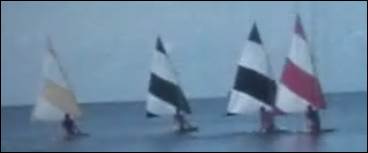
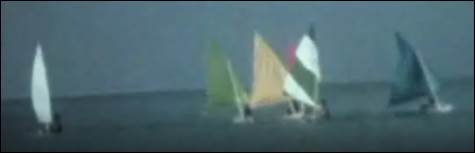
The finale for all these Caribbean boats came as my contract came to an end and just before we left to return to UK. A grand annual Regatta was to be held in South Caicos, and the islands Governor asked if the Flatties could take part. What organisation this took. The boats and 20 pupils plus another teacher, were flown over from Grand Turk to South Caicos in an American air force Transport plane, together with my wife and my four children. I and Derek motored over the previous evening in Turkey, my longest and scariest voyage so far at 22 miles and out of sight of land in the middle too. By this stage I had bought a second 50hp Mercury outboard and they were both steering and working together which gave us a little security, though we did not have a compass or any radio.
The regatta was a great event with class races for local sloops, the Flatties and motor boats too. I have to add that Turkey won both events in the outboard class, as I guessed we would. I had already sold the boat to the new Cable and Wireless manager, Peter Wolf who was interested in fishing, and so we gave him the trophies. That night we set off for Grand Turk again in Turkey, but the seas were against us, and we could not safely stay up on the plane. We had not enough fuel to motor slowly and so we had to turn back. We flew back the next day in Derek’s friend’s private plane, and with only two days to go before our final flight away from Grand Turk back to UK, you can be sure that I was not Julie's favourite person when I got back a day late. Final packing still to do, including the new 50hp Mercs to put into its packing crate for shipping back to UK and Trix.
I really did not want to leave the islands at all, the teaching was the most rewarding I had ever experienced, and the self reliant life was for me just perfect. The general standard of education was however far behind UK standards and Julie was keen to get our four children back into 'real school'. As I boarded the plane back to England, I made a vow to myself that one day I would return, under my own steam, and to stay for as long as I wanted to.
CALTHORPE PARK
My teaching then moved to a new secondary school in Fleet, where another craft teacher was a keen canoeist, and pupils were soon into building fibreglass canoes using moulds borrowed from the Hampshire Education department outdoor pursuits in Calshot. Two, plywood 'Flatties' were built back in UK, but were wet boats to sail, not a huge success given the cold water and inclement weather, not to be compared with the constant sunshine and bright warm Caribbean Sea. One was built by Trevor Hosken, and another by John Wright, who did some sailing with his school on a small lake in Tongham. He also had there a Bosun dinghy which I was able to try out, the first time in that size of boat I think. Trevor Hosken launched his on Fleet pond one evening, but there was not much wind.
‘CHOPPERS’. CHILD’s MODEL FIBREGLASS SAILING BOAT.
As Calthorpe Park school grew, we built and equipped two new workshops in addition to the original wood, metal and drawing workshops. One was to be for engineering and one, a new innovation for Hampshire, dedicated to 'plastics', the range of new materials quickly taking over all aspects of our 1970’s lives. I took over this teaching area, having attended two summer school courses at my old College and become very interested in the huge range of practical applications for the materials.
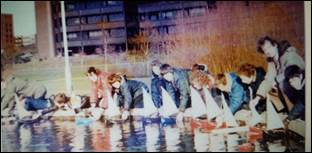
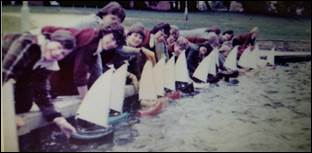
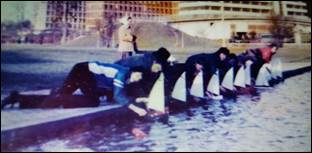
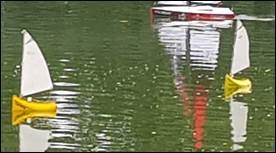
After intial setup, as new teaching courses emerged, once again boats came into the picture. John Beattie, the canoeing woodworker, had a friend who designed model sailboats professionally, and he was able to borrow a mould for experimenting. It was a simple and strange design, just 14 inches long, a toy really, suitable for any child from 4 years and up, but which actually sailed very well on all points except down wind, and with just one sail. Two identical half moulds with a built in aluminium tube mast, a small cast lead keel and foam floatation, it was shaped like an axe head, and called a 'Chopper'. All the craft staff made one each, and we were hooked ! We obtained permission from the designer, to mass produce these, though not for sale, and we produced 20 moulds. Soon we had whole classes of 18 pupils making one each over a ten lesson course, each one with its own sail number and registration. For a 13 year old boy, it was a winner, specially as the last lesson was actually racing their new boats on the Basingstoke pond, with willing parents providing transportation. As a ‘plastics’ teaching aid it was all inclusive. Lead casting, fibreglass hand lay-up, foamed floatation, injection moulded fittings, and hand cut terylene sail, every part made by each individual pupil and brought together as one project. Choosing the colour, and even the choosing of names was exciting, and rub on lettering, obtained free from the 'Letraset' manufacturers gave a professional finishing touch. Over the next few years, there were well over 600 of these individually produced. Still, years later I meet parents who tell me, "we still have his sailboat on top of our wardrobe", (and I have even sailed three of them with my great grandchildren, in 2014. )
TRIXOLAR BUILD
Family growing up, cubs and scouts, swimming clubs, and schoolwork, building up a large craft department in Calthorpe School Fleet, left little time for other activities for several years, though we continued to water-ski in the holidays and at weekends with friends. In the late 70's school problems, such as too many pupils, equal opportunities, and changing curricula, too much paperwork and reports, finally became overbearing. Sleep at night was fitful and I needed something outside school to keep me sane. I still kept my watch bezel showing 'Turks time' and often thought of life back on the island.
In my last few months on Grand Turk, I had been persuaded by Derek Softley, to subscribe to a new American magazine called 'Trimaraner'. While ministering his flock in West Caicos he had been invited to a party onboard a new type of sailboat with a centre hull and two outriggers, built lightly of plywood, and NOT using a heavy keel. A great boat, very stable, and unsinkable he insisted. On his meagre stipend he could not afford the ‘Trimaraner ‘ subscription and so I bought it and we both read it. After only three editions however it folded up and a new publication soon took over called ‘Multihulls Magazine‘, and I subscribed to that one from the first edition, and was still a subscriber for their 25th year ! I had my name printed in that edition as a lifelong subscriber.
My desire to return to Grand Turk, my dissatisfaction with the direction that technical education was taking, and my interest in boatbuilding, particularly multihulls, all came together in a possible new venture. I wanted to build a boat capable of taking us back to Grand Turk, and so in 1975, I set about researching possible designs, writing off to ten designers advertising in Multihulls magazine.
I had been reading the theory and practical applications of multihull construction with new materials for years, with no particular intention in mind. Monohulls had always been an anathema in my eyes. Why make something designed to float and then to weigh it down with lead or ballast ? It seemed a contradiction in terms, and there must be other ways of counteracting the 'tipping' action of the mast and sails. I had learned that the Hawaiian and other island dwellers had solved the problem centuries ago, sailed huge distances very quickly and safely using their canoes with a bamboo float well out on the side for support, called an outrigger, aka or ama. Some canoes had the support on the lee and others on the windward side which rose out of the sea when hard pressed. Rafts and two hulled craft, catamarans, had been experimented with throughout history but had been unsuccessful due to traditional sailing and racing pressures and also the lack of suitable light materials. New modern materials, easily obtained cheap plywood, and the newer fibreglass proved to be the link between the old and the new. In the early 1960's, an American, Arthur Piver in San Francisco, began to build new designs and sail them fast, and long distances too. He tended to exaggerate, but he quickly caught the imagination of the younger sailors around him and 'the word' spread.... Trimarans.
Why three hulls and not two ? A question that has occupied many minds as well as my own, and continues to do so. I felt sure in my mind that anything less than 40 feet needed to be a trimaran, while above that length, a cruising catamaran may have the sailing advantage, but made a huge boat, much too big for a husband and wife crew.
My trimaran designer search was soon narrowed down to two, Norman Cross and Jim Brown, both of them young friends and admirers of the older Piver. I went to see a builder of a 35 ft Cross design in Norwich and helped him turn over one of the outriggers. On looking at his plans which were very basic, I came away with the concern that I did not know enough about sailing, and nothing at all about cruising, to enable me to build one of these designs.
Next I bought a book from Jim Brown, 'The Searunner Construction Manual', and read it until I could quote it by heart. That book was so detailed and full of practical ‘know how', that now I knew I could build it, and the 37 ft design was big enough for ocean going and small enough for an inexperienced crew of two. The plans were bought for $200 ( 37 ft Searunner, sail number .??) and studied along with the manual. Tentative costings were made and it began to look possible. Julie was very supportive in my endeavour, though insisting, "Don't expect me to go in it, you know how I hate the water." She knew the pressures of my school work and she was also training to teach dressmaking in college rather than only the adult evening classes that she was taking at the time..
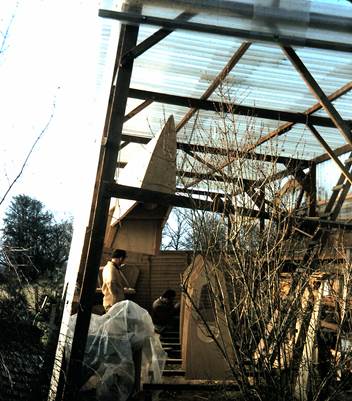
In May 1976, on my 40th birthday I cut out the first plywood frame. I had built a temporary shed in the back garden, 40 f t long with only one side a roof, and no ends, built of second-hand timber from dismantled Aldershot barracks, and cheap 'faulty mould' corrugated plastic, The solid timber specified for the boat, douglass fir was being specially kiln dried, and our sun lounge was filled almost to the roof with 200 sheets of mahogany ply wood of various thicknesses, according to the 'list of materials' in the manual. That Summer, as usual, we had our family holiday in the Bedford Camper, a full 6 weeks in southern Spain and France. Our eldest daughter spent some time with her French exchange student, and the other three teenagers came with us. Though we had a great time, they were beginning to grow away from their parents and it was the last Summer holiday that we all spent together.
I began building in earnest in October, and spent most weekends and every school holiday working in the shed. I did have lighting, but limited my work to daylight hours in deference to my neighbours on either side. One side Sid Blachford, took a delighted interest, and the other side, Stan Googe immediately broke off relations and did not speak for the next ten years. I had joined an inland sailing club in Fleet, who hosted visiting speakers during the Winter months,, and began to take night classes in Navigation. Other club members would periodically come to view the building, some guessing that it would never reach completion and others enthusiastically supportive. Friends were always dropping in to view progress and bringing their friends to see this huge boat taking shape in the back garden. It really did look huge in the confined space. The outriggers were finished and covered in fibreglass, and then the main hull constructed. Pulleys and ropes rotated the hulls for fibre-glassing, and when all three hulls were made, we had a party for all our friends to position and fit the crossarms to make one vessel.. The one side of the shed was raised to make a complete covering roof with no sides. To reach this stage took just two years, and it looked almost finished, but in fact the difficult part was yet to come.
The interior, bulkheads, galley, head and bunks took so much time, and the painting took far more paint and time than I had ever imagined. A friend Malcolm Raffell worked for Shell, and got a huge discount from marine paint which he kindly allowed me to use, but I still only bought half of what I eventually required, the only miscalculation of the whole project. Eventually the decks were covered in, the interior fitted out, and the final coats of paint were spayed on. It was during this stage that Julie began to take an active interest. Jim Brown suggested that a hole cut in the wing would suffice for a toilet. "It had better have a good toilet if you expect me to go on it", and "You've got to have a grill, whoever heard of a kitchen without a grill". She came to all the Boat Shows, and then did much of the finishing work, upholstery, curtains, buying bedding and kitchenwares. It was she who made it into a home instead of merely a boat.
The thoughts of moving the apparently huge boat from the back garden over the hedge and down to the sea had occupied many a restless moment. At two boat shows I had made contact with a trucking company, and before joining the three hulls I had a representative from Bristows come to survey the problem. He confided that strictly by law it would not be allowed on the roads, (only nucleor reactors and the like), but he thought he knew enough officials to override the problem. Three years later I was relieved when he was still confident, and one Sunday in March 1982 a crane lifted her right over the hedge and onto a low loader trailer waiting on the waste ground behind the house. During the whole of the build time, 5 years, there had been plans and rumours of houses going to be built behind our garden, and just 6 months later, there were 5 new houses in that field !
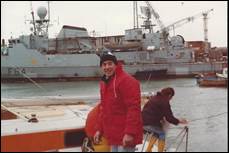
Launched in the Spring of 1982, at Camber Dock, Portsmouth, and christened Trixolar, by Julie and my two daughters each breaking a bottle of Lemonade over the three hulls simultaneously. We all then drank the champagne as the rigger and friend John Sayer, got to work on raising the mast. In Multihulls Magazine later we even had a photograph of Trixolar, 23 feet wide, negotiating the wrong way round a Portsmouth roundabout, with half timbered buildings in the background. At that stage I could never have imagined the effect on our lives or the adventures I would have over the next 20 years.
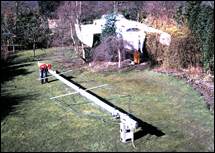
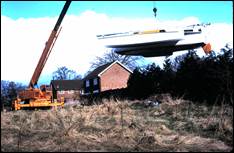
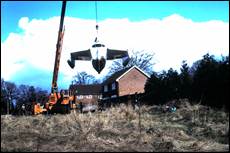
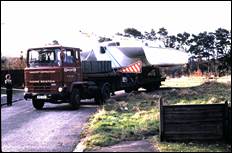
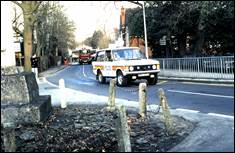
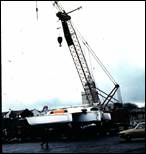
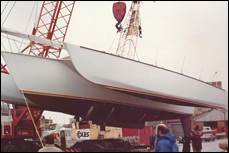
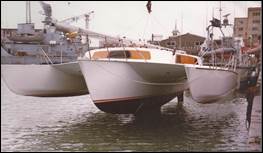
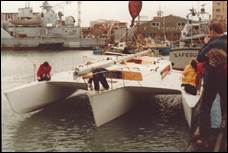
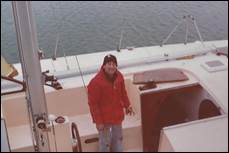
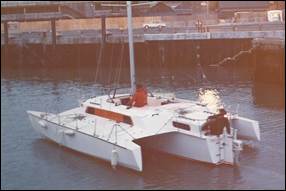
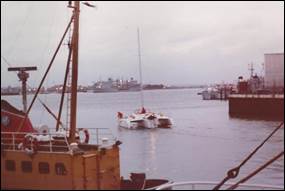
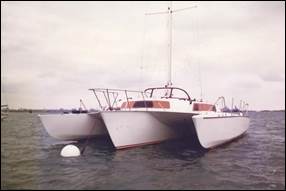
Trixolar had been a hard name to finalise. A TRImaran for the sun, trisun ?, No.... Sun, solar... Tri-solar, Trissolar, sounds like a cooking oil ! Finally my Dad came to the rescue, suggesting, put the X in the middle, as in my original first model sail boat, TRIXOLAR.
The boat shed was demolished, but keeping some materials to build a potting shed, the plot was dug over and planted with potatoes, the hedge trimmed and attempts made to normalise relations with neighbours. Neighbour Sid, who now lived in USA, came back to sail with us on several occasions, but Stan, on the other side, kept his silence for another five years. What a waste of life ?
It happened that during the boat build, family life changed drastically. The year building began, 1976, was the last time that we all spent the Summer holiday together camping in France and Spain. The children were all teenagers, and from then on, rapidly grew away from us and into their own lives, which is as it should be of course. Julie to had a greater interest in her teaching when she qualified and took up full time 6th form teaching, 'Costume dress and design'.
Most weekends and every holiday, we now went off to the boat. Mostly we took friends. Pete Muhs, one of the young teachers at Calthorpe Park, often came and helped with all the small jobs that still needed work, the outboard engine steering I know was difficult to get working efficiently. We sometimes went to the Fleetway sailing rallies, where we learned from the other members the problems of tides and anchoring around the Solent. For the first year we had a mooring in Portsmouth harbour, and belonged to the sailing club there, but the second year we obtained permission from the Southampton Water board to lay down our own mooring by Hythe Sailing Club, and so joined that club, though we did not take part in any social activity.
Sailing was a steep learning curve. For several weekends we merely motored round the harbour, practising picking up our mooring, then we tried sailing with just one sail, and then with two. At that time, multihulls, even catamarans were few and far between, and we hardly ever saw another trimaran. From day one we always kept a ships log, and looking back on them now, it seems incredible how steep the learning curve really was.
The choice of engine while building, was difficult. Fit an inboard diesel, or hang an outboard motor on the back ? I had experience already of two Mercury outboards on the Ski boat, but diesels were a mystery. I could buy three good outboards for the price of one diesel, and fitting an outboard seemed the easiest option. Added to that, Jim Brown, the Searunner designer agreed that an outboard was enough to drive the 37 footer along safely. The choice took two years but eventually proved to be a good one. Initially I fitted a 15 hp Chrysler with a specially lengthened shaft. It raised and lowered on a slider, which needed to be done from the back, but the engine was controlled from the cockpit. Directional control was not good, until I fitted a bar connection to the rudder, which improved everything, though it involved some considerable experimentation and design changes. Throughout the building, I was very fortunate in having at my disposal the entire school workshops, with excellent facilities for working wood metal and plastics. Nothing was impossible, a fact that I always stressed with my examination pupils. They were all included in my enthusiasm, and many of them came round to the house during the building phase. All the metal fittings except winches were hand made, even the cleats were cast using my own design pattern and special grade marine aluminium ingots. A fact that stays in my mind is that all 12 cleats specified by the designer were made for the cost of just one at chandelry prices. The steering wheel was laminated from teak, the centre cast, including my own logo, and turned from aluminium. The windscreen was also laminated from teak. An old pupil of mine was working with a company that customised offices for computer use, and as he was well aware of my project, one day he dropped by to tell me that there were several old science laboratory benches being scrapped at the place he was fitting out. I met him the following day in the van, and I came away with two huge bench tops, enough to complete every teak part required, and at no cost. I had estimated at a final building cost of £7000, spread over five years. I kept meticulous audit books, even having a separate bank account for the boat. and every purchase was recorded, every sheet of glasspaper, every nail and screw. On the launch day, the total was £8000, which happened to be on the launch year of the Ford Sierra, (the jelly mould car) costing exactly the same amount for the standard family car. During the next four years we bought other luxury items, an extra sail, a depth sounder and a speed log for instance.
Of course we needed a dinghy. In school pupils were moulding their own personal canoes as a matter of routine, we probably had 20 or so made by fourth and fifth year pupils. A young woodwork teacher John Beattie, was a very keen canoeist, and he ably took over these projects. One boy asked if he could make a boat instead of a canoe, for use on the Odiham canal. There was a fibreglass moulding company on a trading estate in Aldershot, a Mr Spicer, with whom we had contacts, and he was willing to loan us a suitable mould. A 10 foot dinghy, a three part mould, with inbuilt floatation, materials costing twice as much as the standard canoe, but just perfect as a boat tender for me. The outboard motor for this was bought for just £10 from another member of the Fleetway Sailing Association, Dudley Ings, an aged 1.5 hp Seagull which lasted us almost ten years continuous use.
We learned and enjoyed sailing, for five years, even Julie, spending her new salary on boat extras.
By the time I reached 50 years old, I was thoroughly exasperated and disillusioned with the way that practical education was being watered down by computers and the emerging new examinations, and I resolved to leave the teaching profession before I lost my mind. I gave in my notice on my birthday, surprising all who knew me, including Julie ! I knew that with our children already flown the home and settled, I could easily earn enough by renovating and decorating, in my own business, called ‘Moscan‘, a trade name used , and even named while building Trixolar. However, it was Julie who suggested “ how about trying living on the boat and see how we like it ?”.
And so, in July 1986, we set sail from Portsmouth harbour, loaded with tools, bikes, and one passenger, Dave Bell, a PE teacher who was off to ride a cycle tour in France, our first stop. TRIXOLAR was our home for the next ten years, safely taking us down the West African coast, across to Brasil, south almost to Argentina, and then up to the Caribbean sea, and the USA. Finally sold in 1996 when we returned home and took over our house again.
Sikaflex Challenge.
We were home for some of the summer in 1993, and a friend in the Fleetway sailing Club suggested that I might like to enter for a competition which was to run during in the September Southampton boat show, to advertise the product called Sikaflex which was a thick waterproof glue compound sold in tubes. I asked Trevor Hosken if he would be my building companion and he agreed. I designed a sailing canoe, which I thought we could build from sheet plywood supplied during one 8 hour day session, using no fixings, except for the glue compound. This we did, with an audience of interested passing members of the public. There were two boats being built on each of the 7 days, and at the end of each day, the two boats were paddled in a race round the buoys in the harbour. On the last day of the show, all 12 boats raced with sail only, round the same course. Points were awarded for the design, building time, paddling time, and position in the sailing race. We won with top points. Later that Autumn, when I had returned to the Caribbean, Trevor entered a charity race from Southampton and sailed the boat over to the IOW.
Monohull Sailing.
I have already told of my distrust of sailing boats that rely on a lead weight to sail upright, seemingly contrary to the primary need to stay afloat on the surface without sinking. My very first venture into model sailing, with my Dad, when I was very young taught me a lesson.
In adulthood I had experience of various small dinghies without lead keels, notably fun on John Sayers first polythene foam sailing boat, over to the Isle of Wight and later, on his cruiser ??. Also I had sailed briefly with other cruisers, Allan and Eileen Sharples, in his 33 ft Westerly Discus ‘Staffa’, Scilly islands, and in the Mediterranean in Spain, Then in August 1997, I was persuaded by Roger Anderson to accompany him on his first venture in open sea passage-making, to deliver his very well founded and equipped modern 34 ft Vancouver , ‘Lucy Maria’, from his home port on the Thames estuary down to Grenada in the West Indies. Another young crewmember was an off duty fireman..
We sailed via Madeira, and then from the Canary Islands direct to Grenada. In spite of the perfect condition of the boat equipment, sails and rigging, and the competence of our captain Roger, it was the most dangerous and uncomfortable sailing I have ever experienced. We had good weather on all sections of the trip, and the boat sailed well without any problem.
BUT, on downwind sections, the majority of the time, the rolling was unbelievable, often a constant 60 degree roll, with the boom and foresail clew alternately touching the sea on each side. It was impossible to relax in my bunk even with the bedding and my clothes jammed in around me. Simple tasks like brewing a cup of tea required skill and perfect timing in order not to spill boiling water, or scold your hand. My first and only experience of changing the foresail and rigging the spinnaker pole was without any doubt the most dangerous task I have ever undertaken at sea, strapped in my harness and moving around on the sloping and bouncing foredeck. The boom and foresail pole were tied in such a way that to turn around,, for a ‘man overboard’ would have taken more than 30 minutes without doubt. The whole trip was completed without any incident or problem, all crew worked together with absolutely no conflict of personalities or sickness, and the experience was certainly a pleasure, arriving in Grenada after ? days in total, and ? days sailing. BUT, I was ever more convinced of the pleasure and safety Multihull sailing.
MAXOLAR.
I decided that having sold Trixolar, and then the catastrophic shock of losing my wife Julie, in a bicycle road accident, that I dearly wished to continue with the cruising and travel life, and so it was that from Grenada, I was able to hitch-hike with cruising friends, on several sailboats, ??? around many of the Caribbean Islands, looking for a replacement multihull. I looked at many, with two and three hulls, of many varied designers , sizes and configurations, fibreglass and wood construction. Many had good features, for living and for sailing, but for one reason or another, none came up to my knowledge and experience of Jim Brown’s Searunner designs.
In February 1998, I decided to fly on to Florida, where I knew that Searunners were popular, and advertised in marine papers and magazines, I was fortunate in being able to stay with the new owners Bud and Judy Puch, on my own Trixolar, currently moored in ‘Waynes’ Florida boatyard and marina in LaBelle. Then using their VW campervan, we spent two days driving round and looking at around seven Searunner tris for sale. On 16 th February 1998 I found a 40 ft Tri, and after enquiries and several phone calls to the owners, who were friends of Bud and Judy, I bought Galeana. I was helped in my decision by Audrey Hill, a friend I had known for many years. She had joined me briefly in the Canary Islands, and again we met as I arrived in Florida on Feb 14th…. My exact words to her on the deck of Galeana, “ If I buy this boat, will you come sailing with me?” Her affirmative answer fashioned the whole of my future life and gave me a complete new beginning.
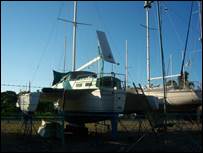
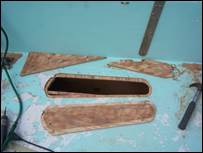
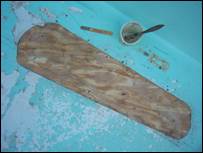
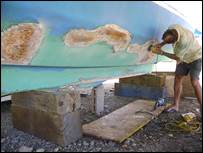
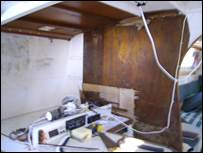
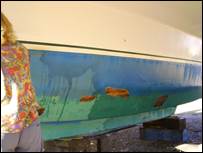
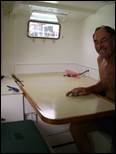
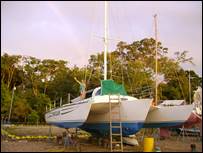
Galeana, another Searunner trimaran, was 3 ft longer than Trixolar , but equal in every other respect. It was what I called a ‘fixer-upper’, needing lots of care and attention to bring it up to sailing readiness. Bud helped me to motor along the Intra-coastal waterway up to Waynes yard in Labelle, where it was hauled. I then spent 3 months working and renovating, with some very basic rebuilds, finding evidence of a fire on board, a rotten centreboard and minikeel. The following year, October to April 1999, we launched again, having registered the boat as British, and re-named MAXOLAR, (maximum sunshine, and larger than Trixolar ), with Audrey filling in the paint on the name. We sailed over to the Bahama Islands and back, a total of over 2000 miles, finding many more faults to remedy, including the need of a total engine rebuild. These major deficiences were fixed during Autumn 1999, and I also built a new 15 ft dingy MINNOW, in five days, as the small 10 ft one MICRO, that we bought with the boat had proved too small and slow for snorkelling trips out to the reef. The dawn of Jan 1st 2000 saw us crossing the Bahama Banks in company with Bud and Judy on Trixolar, and also Sid and Julie Blachford on their catamaran Classicat. That was the start of our real cruise, during UK Winter months only, back to the Caribbean, Cuba, Venezuela, the whole North coast of S America, Panama, Mexico, and back to Florida. We sold MAXOLAR, on 12 April 2010. We vacated the boat a week later, on 19th, having moved on only 13 days in the last four months, a sad ending to a fantastic 12 years of winter cruises with Audrey.
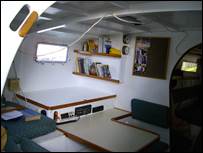
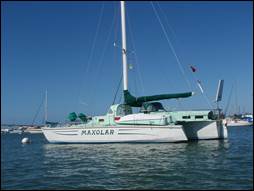
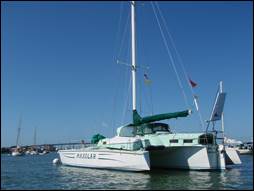
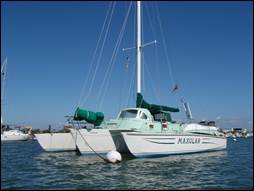
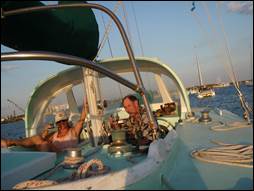
That should be the end of my long history of boats and sailing, as, at the age of 74, in Peru, we had decided to continue our travels overland, visiting the other two thirds of the globe, using land travel. This, I am now doing, but in fact, over the last five years I have been very fortunate to have a very good friend Scott Blades and wife Alison, who charter 39 ft luxury catamarans all over the globe, and I have been very fortunate to sail with him in many new parts of the world.
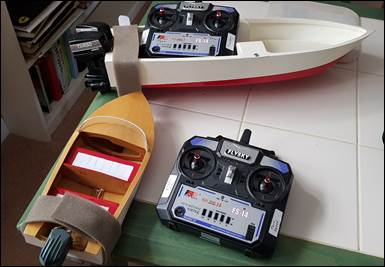
I am also at 79 years of age, back to where I started seventy five years ago, with Dad’s model boats. I have bought, built and sailed, a remote controlled, one meter sailing Trimaran plastic kit, and am now in the process of scratch building wooden RC models of my first two ski boats, TRIX and TURKEY, in the living room, on a bench top with a vice and hand tools. More sedate and not so exciting, but enough for now.
UPDATE MAY 2020 .
Obviously my sailing days are not over. These good friends Scott and Alison have bought their own 40 ft Catamaran, and I have been really privileged to sail with them in Austrailia, the Great Barrier Reef, and also in the Mediteranean round Turkey and Greece, and also two weeks back in the Caribean Islands.
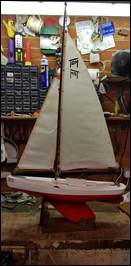
My remote control Model boats , Trix and Turkey are fully functional, with the essential help of my son Trevor, and he has even installed remote control in my original model sailboat TRIX built by my Father for me aged 6.
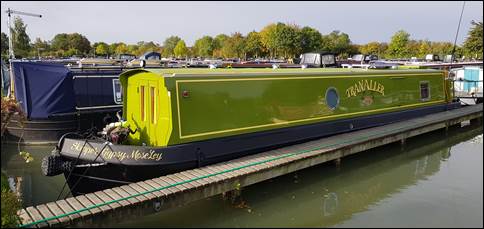
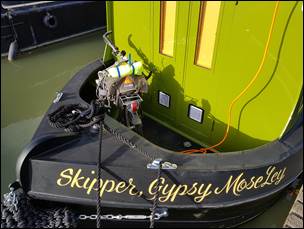
And another boat is proving interesting. In 1997, I bought a new CANAL NARROWBOAT, 40 FT long, and called TRANALLER,. (TRAveLLer on a cANal ). It was intended to be a leisurely way of cruising on the water, no waves or wind problems. BUT it is proving not to be so relaxing, with a multitude of locks, requiring extreme winding of handles, and pushing of lock gates. Now aged 84, only time will tell how well we can adapt our lives.